
CE vs. CE – Same Letters, Very Different Story
If you’ve spent any time shopping for marine electronics, battery chargers, inverters, diesel heaters, or any other gadget manufactured on Planet Earth, you’ve probably seen the familiar CE mark.
ACTUAL CE MARK:
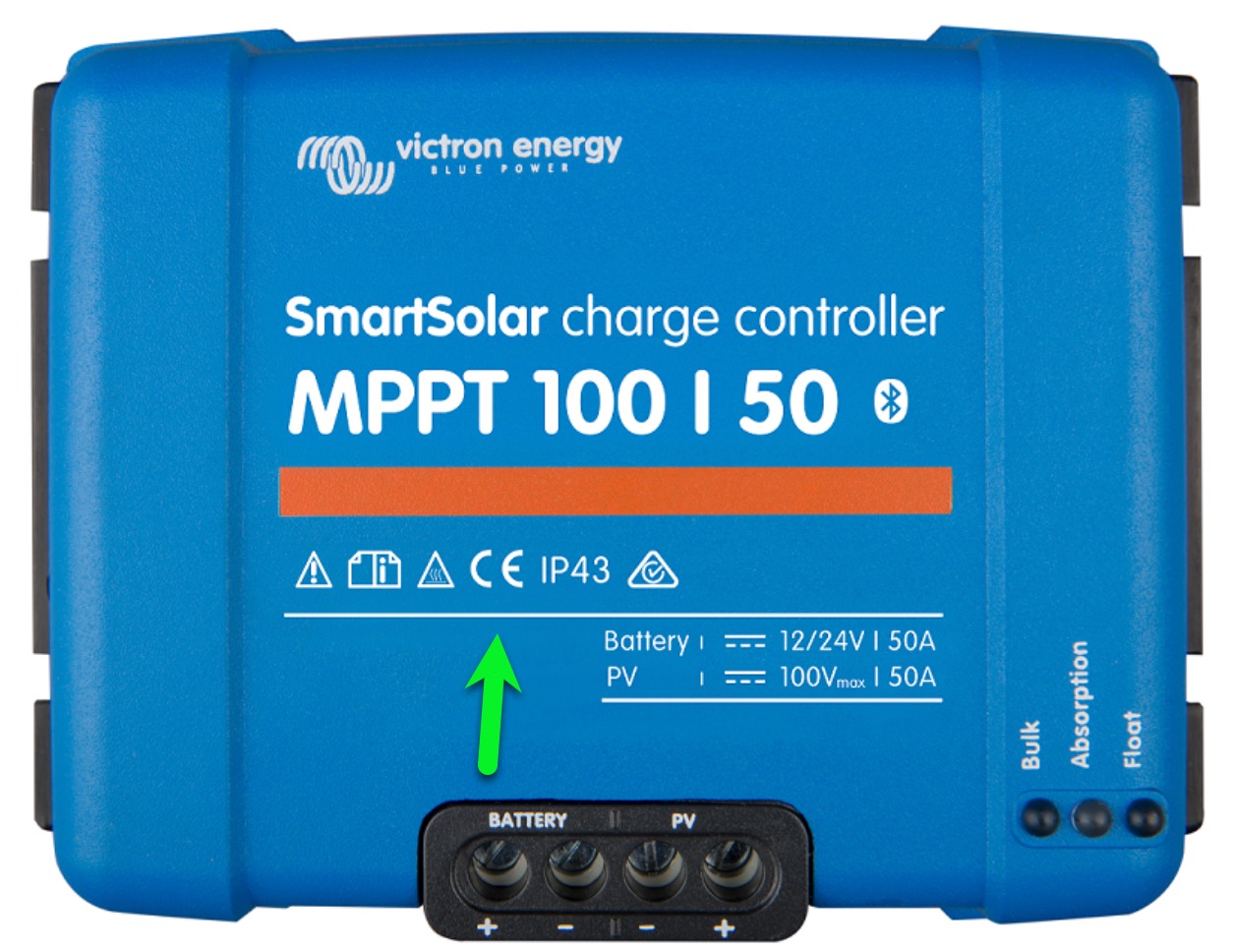
Unfortunately, you’ve also probably seen its evil twin.
No, not the one with the goatee.
The one that looks almost identical.
The one many IN THE KNOW refer to as the “China Export” mark.
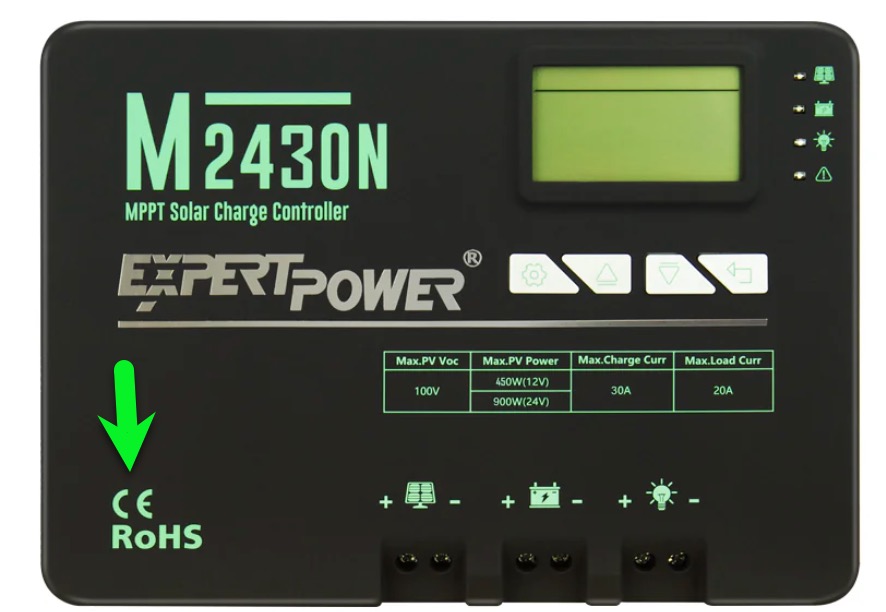
At first glance they appear nearly identical, that’s not an accident. Pay attention to the middle line in the E in this MPPT, controller wearing a phony CE mark….The middle line in the E is a smaller font.
The official European CE Mark stands for Conformité Européenne (European Conformity). It is intended to indicate that a product complies with applicable European health, safety, and environmental requirements. For many products sold into the European market, the manufacturer must maintain technical documentation and demonstrate compliance with applicable regulations.
The look-alike mark, often referred to as “China Export,” carries no recognized EU conformity meaning. It does not indicate testing, certification, compliance, safety, reliability, quality, longevity, or that your boat won’t smell like burning epoxy after you plug it in.
Spot the Difference
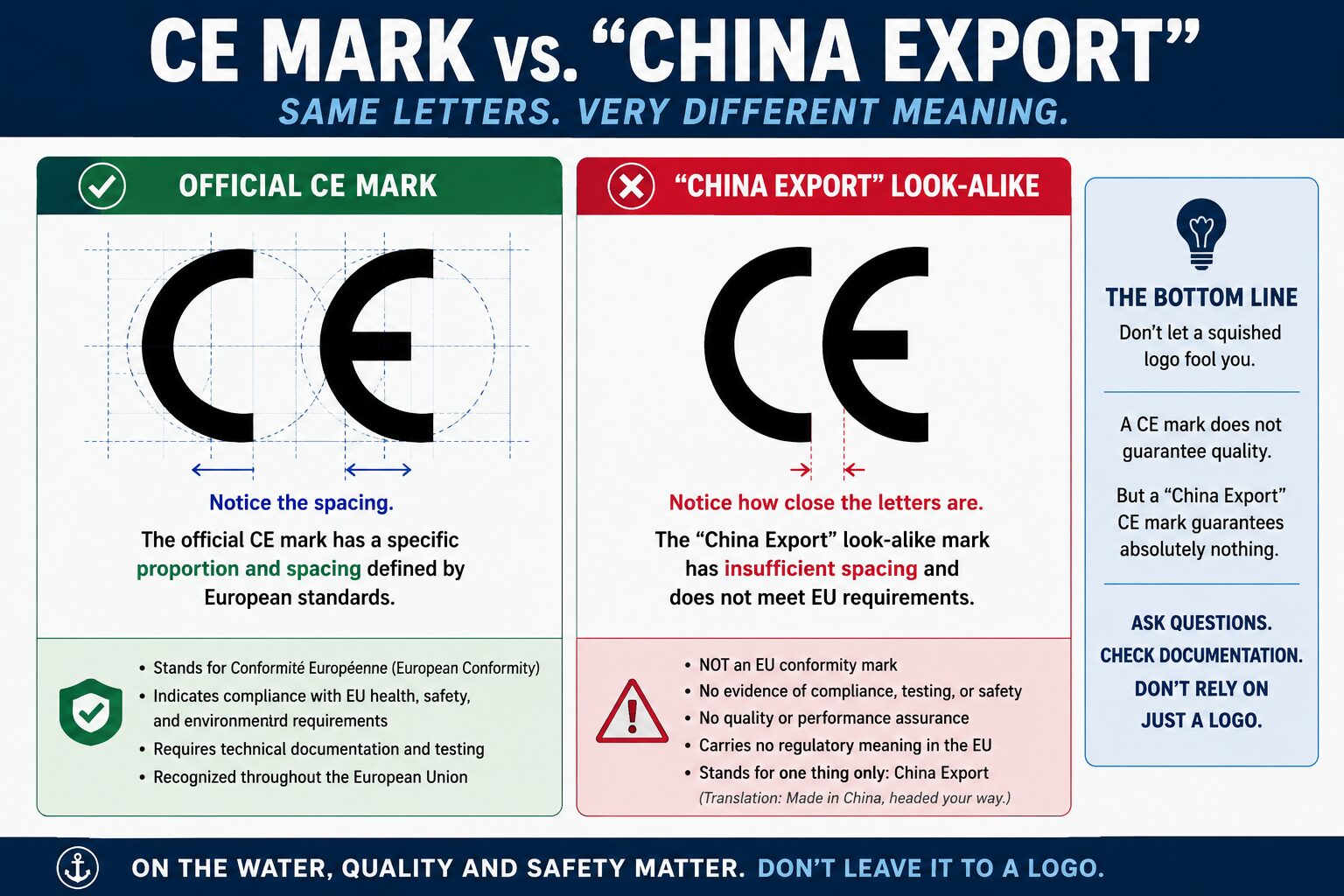
The easiest visual clue?
Spacing.
On the legitimate CE mark, the letters are separated according to a very specific geometric design.
On the look-alike version, the letters are pushed much closer together.
Think of it this way:
Real CE: “We’ve at least done the paperwork.”
China Export: “We own a printer.”
That doesn’t automatically mean the product is junk. Plenty of excellent products are manufactured in China. In fact, many of the best marine electronics on the planet are built there.
What it does mean is that the mark itself tells you absolutely nothing useful about quality.
The Dangerous Assumption
The problem isn’t China.
The problem is consumers assuming that every CE-looking logo means the product has undergone meaningful scrutiny.
It doesn’t.
A CE logo can be printed with the same ease as a skull-and-crossbones sticker or a picture of a unicorn.
Ink is cheap.
Compliance testing isn’t.
That’s why smart buyers don’t stop at logos.
They ask questions:
- Is there a Declaration of Conformity?
- Is there technical documentation?
- Is the manufacturer identifiable?
- Does the company have a real address?
- Can they provide EMC test reports?
- Does the charger, inverter, or battery have actual support?
If the answer to those questions is crickets and tumbleweeds, the logo on the label probably isn’t your biggest concern.
The MarineHowTo Rule
When evaluating marine gear, I place CE logos somewhere between:
- The marketing brochure.
- The sticker that says “Marine Grade.”
- The manufacturer’s promise that their 100Ah lead acid battery is actually 100Ah.
In other words:
A logo is not evidence.
Documentation is evidence.
Testing is evidence.
Engineering is evidence.
A random symbol, not so much.
Bottom Line
The genuine CE mark is a European conformity mark tied to regulatory requirements.
The commonly referenced “China Export” look-alike mark is not an EU compliance mark and provides no assurance of safety, quality, performance, or durability.
When buying marine equipment, don’t confuse a logo with proof.
Because electrons don’t care what sticker is on the box.
And neither does smoke.
PLEASE HELP!
This site is 100% reader supported. My wife is urging me to shut it down as it just keeps costing us money. My stroke-recovery, PT & OT is very costly & not covered by insurance as is authoring this site and keeping it secure. Click BUY ME A COFFEE if you want to support this site.
