
.
Copper-Clad Aluminum Wire = A False Economy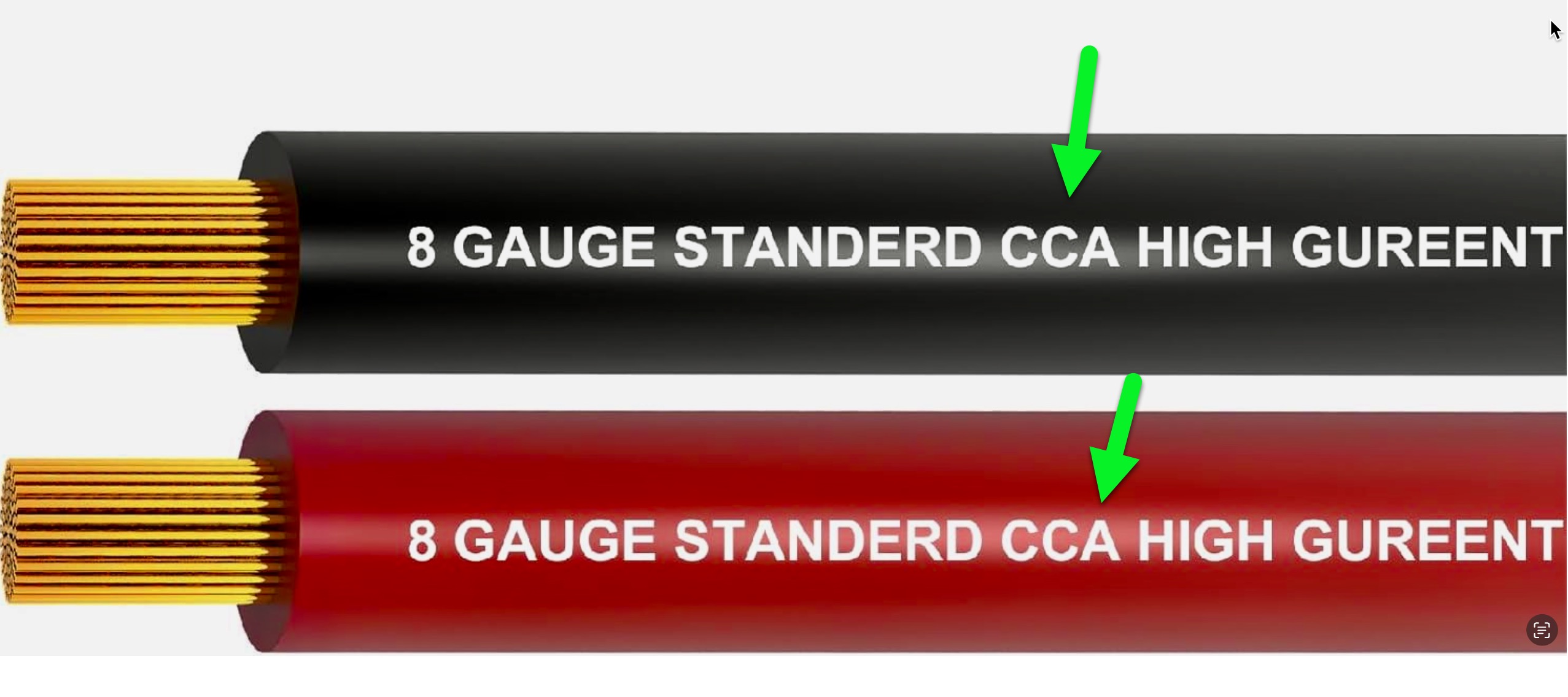
Every few months this comes up again, usually after someone finds a “great deal” on wire that seems too cheap to ignore.The company above can’t even spell Stranded ( STRANDERD) to Current (GUREENT), but I digress..
Spoiler alert: It is a false economy
Copper-clad aluminum (CCA) wire is often marketed as a cost-effective alternative to marine-grade tinned copper. On price, it looks attractive. In the real-world, especially on boats, it’s anything but.
For about two + years now Amazon and other online retailer have been sneakily selling undereducated customers aluminum wire that has a thin copper coating. They often sell it as if it was pure copper.
The Problem: It’s Not Copper!
CCA is exactly what it sounds like: an aluminum conductor with a thin copper coating.

The issue?
Aluminum only conducts about 60% as well as copper.That’s not a small difference. That’s a massive penalty in low-voltage DC systems where every tenth of a volt matters.
Voltage-Drop Is Where It Falls Apart
Most of the marketing around wire focuses on ampacity. That’s convenient, because ampacity hides the real problem.
Voltage-drop is what actually matters on a boat.
- Charging systems depend on voltage
- Inverters depend on voltage
- Electronics depend on voltage
CCA wire has significantly higher resistance than copper, which means:
- More voltage drop
- Less charging efficiency
- Poor inverter performance
- Heat where you don’t want it
To get the same performance as marine-grade copper, CCA needs to be upsized dramatically.
We’ve created This Chart to show the differences in AWG sizing:

The Reality: Bigger, Bulkier & Still Worse
In practical terms:
CCA wire needs to be 2-3 AWG sizes larger than copper just to keep up.
That means:
- 10 AWG copper → ~6 AWG CCA
- 4 AWG copper → ~1/0 CCA
- 1/0 copper → ~4/0 CCA
And even then, that’s just to match voltage drop on paper.
In the real world:
- Terminations are worse
- Corrosion resistance is worse
- Mechanical reliability is worse
Marine Environment? Forget It.
CCA wire is NOT marine wire ads DOES NOT meet the minimum ABYC safety standards!.

CCA does not meet the standard and it was never designed for:
- Moisture
- Salt exposure
- Vibration
- Long-term reliability
The thin copper cladding does not protect the aluminum core once it’s nicked, terminated, or exposed.
FAIL!

From there:
- Corrosion accelerates
- Resistance increases
- Problems compound
Until Nothing is Left!

The “Savings” Myth
CCA is sold on cost.
But once you:
- Upsize the wire
- Deal with bulk and routing issues
- Accept reduced performance & Corrosion
- Made Your Boat Uninsurable
You haven’t saved money—you’ve just bought inferior performance at a discount.
On a boat, that’s a poor trade-off.
Bottom Line
If you care about system performance:
CCA is a downgrade in every meaningful way.
- Higher resistance
- More voltage drop
- Larger wire required
- Worse durability
- Not marine compliant
Use if you want to redo the job later, Otherwise, Use tinned copper UL1426 marine wire and be done with it.
PLEASE HELP!
This site is 100% reader supported. My wife is urging me to shut it down as it just keeps costing us money. My stroke recovery is very costly as is authoring this site and keeping it secure.
Click the DONATE button below if you would like to make a donation via BUY ME A COFFEE.
