
Lead is Dead! (Except for Starting Batteries)
Warning: This article is long and detailed—it may require two reads to fully grasp the nuances and important details.
You might be wondering why I’m declaring that lead is dead. The answer is simple: lead-acid battery manufacturers have dug their own graves by repeatedly misleading the public. They know full well that their batteries will never meet the cycle-life claims once they’re deployed in the real world, where partial state of charge (PSoC) operation is the norm.
Why not? Because the real world isn’t a pristine, white-lab-coat, white-glove laboratory. In the real world, sulfation happens—and it kills lead-acid batteries far earlier than advertised claims lead you to believe.
Not long ago, I was on the phone with the top-selling lead-acid battery vendor on Amazon. They recently began offering LiFePO₄ batteries after noticing a massive slump in deep-cycle lead-acid sales. Since introducing LiFePO₄, their LFP sales now outpace lead-acid roughly 2 to 1.
Lead Acid Cycle-Life Claims vs. Reality
Claims of 1,000, 1,200, or even 1,600 cycles are about as believable as Jim Gaffigan beating Usain Bolt in the 100-meter dash. In a sailboatowners.com battery usage survey—the largest of its kind, with 1,480 users responding—the overwhelming majority of boat owners reported getting maybe 150 cycles out of their lead-acid batteries. That’s 150 cycles! Many of these batteries were sold with claims of 1,000+ cycle life. It’s laughable.
Lead is dead—and the manufacturers have no one to blame but themselves. By grossly misleading their customers about realistic cycle-life expectations, they’ve essentially pushed users straight into the arms of LiFePO₄. Had they been more transparent, the mass migration to lithium might not have been so aggressive.
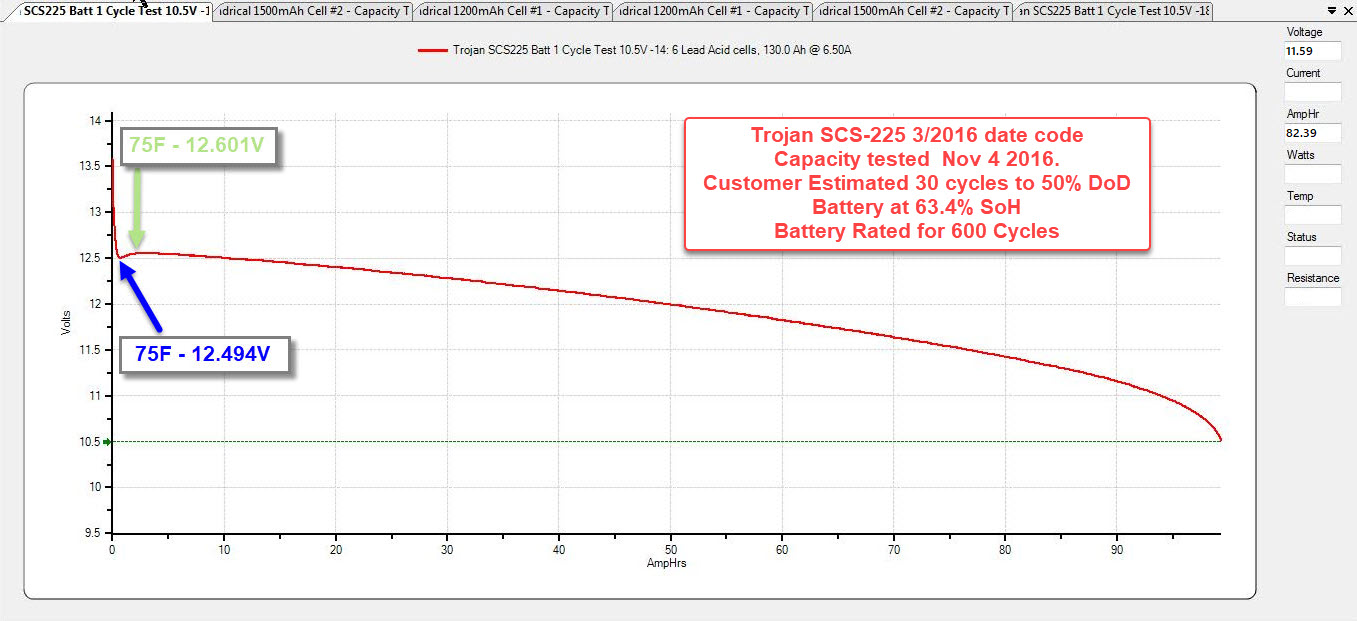
The image below is just one example of why I call lead-acid cycle-life claims a joke. I never make a claim like this without hard data to back it up.
Capacity Testing = Lead-Acid Reality
At Compass Marine Inc., we’ve been capacity testing lead-acid batteries for more than 20 years. While the test equipment has gotten better over time, sadly, the quality of the batteries hasn’t.
One unfortunate example: A customer purchased a brand-new bank of Trojan SCS-225’s in the spring. His boat was on a mooring, and he had no solar. I warned him those batteries might only last one to two seasons, but he was optimistic—after all, Trojan claims up to 600 cycles at 50% depth of discharge.
Reality? After just one season, the bank tested at 63.4% state of health. That’s nowhere near acceptable.
By industry standards, a lead-acid battery is considered end-of-life when it drops below 80% of its rated capacity. After two decades of testing batteries under BCI protocols, one thing is clear: claims of 1,000+ cycles for lead-acid batteries are pure fiction, right up there with Tinker Bell.
Cost: LFP Wins!
Let’s take a look at some real-world pricing as of 6/18/25:
Lifeline G-31XT AGM (125Ah x 3 = 375Ah bank)
-
Cost: $1,797
-
Usable Capacity: 187.5Ah (at 50% DoD)
-
Real World Cycle Life: ~300 cycles
-
Cost per Usable Ah Over Life: $5.99
(Based on 20+ years of real-world experience and many many hundreds of capacity tests)
WattCycle 314Ah LiFePO₄ (80%DoD)
-
Cost: $529.99
-
Usable Capacity: 251.2Ah (at 80% DoD)
-
Estimated Life: ~4,000+ cycles
-
Cost per Usable Ah Over Life: $0.13
Wattcycle 314n Ah LiFePO₄ (100% DoD)
-
Cost: $529.99
-
Usable Capacity: 314Ah (at 100% DoD)
-
Cycle Life: 2,000 cycles
-
Cost per Usable Ah Over Life: $0.26
Bottom Line
Even when used at 100% depth of discharge, lithium iron phosphate (LFP) batteries are a tiny fraction of the cost per amp-hour compared to AGM or even flooded batteries. The economics speak for themselves, LFP isn’t just better performance, it’s a far better value.
Preface
This article covers 12V (nominal) LiFePO₄ “drop-in” batteries for use aboard boats but the same info can be applied to 24V & 48V systems. It’s also the first article I’ve written since suffering a major stroke on September 1, 2021—a stroke that actually killed me. I was resuscitated to survive but gave up the left side of my body (paralyzed) for the privilege of being alive.. Recovery will never end, and while progress is slow, I’m grateful to be here and writing again, with 1 finger. (grin)
Bare Minimum Features for Drop-In Batteries
If you’re considering a drop-in LiFePO₄ battery, make sure it has at least the following features:
-
Low-Temperature Charging Cutoff
-
Detailed Owner’s Manual
-
Compliance with ABYC Standards
-
UL Certification (required for ABYC)
-
Bluetooth BMS (not required but, critical)
Our Recommended Value Drop-In Battery: Wattcycle
Right now, our top pick is Wattcycle.
These batteries are impressively well-built. Wattcycle offers:
-
Optional Bluetooth BMS
-
Waterproof models
-
A proper cell module for mobile use, not common at this price point
-
Incredible value
Currently, WattCycle is the best overall value when factoring in construction, features, and price. We have Secured an 8% discount on top of the already amazing pricing. The coupon code is: MHT8. (Note: This code does not work on Amazon.)
Buy Discounted Wattcycle Batteries
Current LFP Pricing
Thanks to oversupply in the EV market, LiFePO₄ cell prices are still low-but this won’t last forever. In a three year period LFP cell prices have dropped by 90%. Why? China spent billions scaling up EV battery production, only to see demand fall short. This has left cell manufacturers like EVE, CATL, REPT, BYD, Top Band, etc. with surplus inventory & production.
As a result, drop-in battery builders are now getting high-grade EV cells at prices well below production cost—something nearly impossible just two years ago. Companies like Wattcycle are passing those savings on to the end user.
Best Vale for Victron Integration = Epoch Batteries
If you need drop-in batteries that communicate with Victron equipment, our recommendation is Epoch.
Epoch batteries are built to an exceptionally high standard:
-
Built-in heating
-
One of the best Bluetooth BMS units we’ve seen
-
Waterproof designs
-
CANBUS support
-
Remote display & alarm options
-
Proper cell compression
-
An in-house engineered BMS
Epoch batteries are manufactured by one of the top battery factories in China, a division of EVE, one of the world’s largest and most respected LiFePo₄ cell makers. This ensures excellent consistency and access to EV-grade cells.
Buy Discounted Epoch Batteries
Join the Discussion
Want to learn more or share your experience? Join our growing communities:
Yes, I Personally Use LiFePo4
I’m not new to lithium-ion batteries.
I’ve been using LiFePO₄ batteries on my own boat since early 2010. I built my bank in 2009, before any drop-in batteries even existed. As of May 10, 2025, the bank turned 17 years old, with over 2700 cycles, most of them at 80% depth of discharge & Over 100 cycles went all the way to 0%.
Despite all that use, the bank can still deliver 100% of its original 400Ah rated capacity.
Yes, LiFePO₄ batteries can last. Lead-acid simply doesn’t compare.
Happy 17th Birthday to My LiFePo4
SAFETY
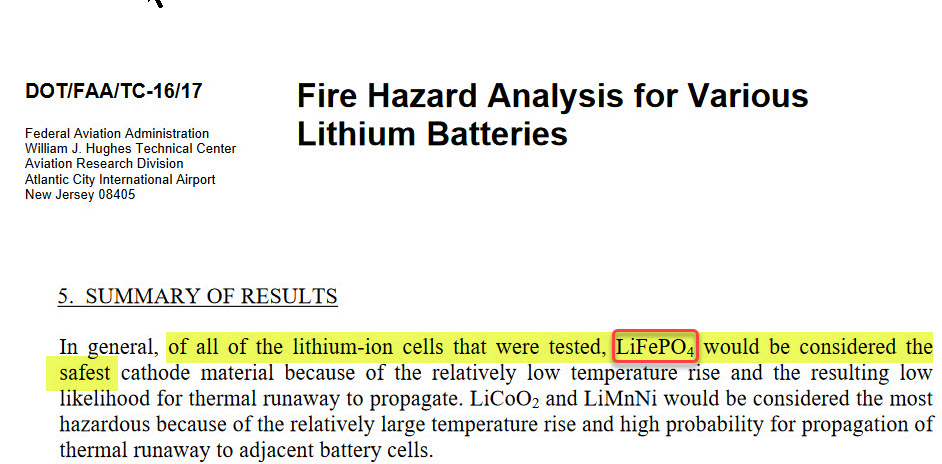
Let’s be crystal clear: LiFePO₄ and LiCoO₂ (the chemistry used in Boeing’s infamous battery fires) are not even in the same universe when it comes to safety. One is water; the other is gasoline.
While both are technically lithium-ion chemistries, LiFePO₄ is far more stable and inherently resistant to thermal runaway and fire. When people lump all lithium chemistries together, they’re either misinformed—or intentionally spreading FUD (fear, uncertainty, and doubt).
And yes, Flat-Earthers still exist, too.
So when you see those trolls out there warning about lithium fires on boats, just ignore them. As the internet saying goes: don’t feed the trolls.
Summary of ABYC LFP Safety Testing
ABYC LiFePo4 Safety Testing Article
Here’s the FAA
Dramatic example of LiFepo4 Safety
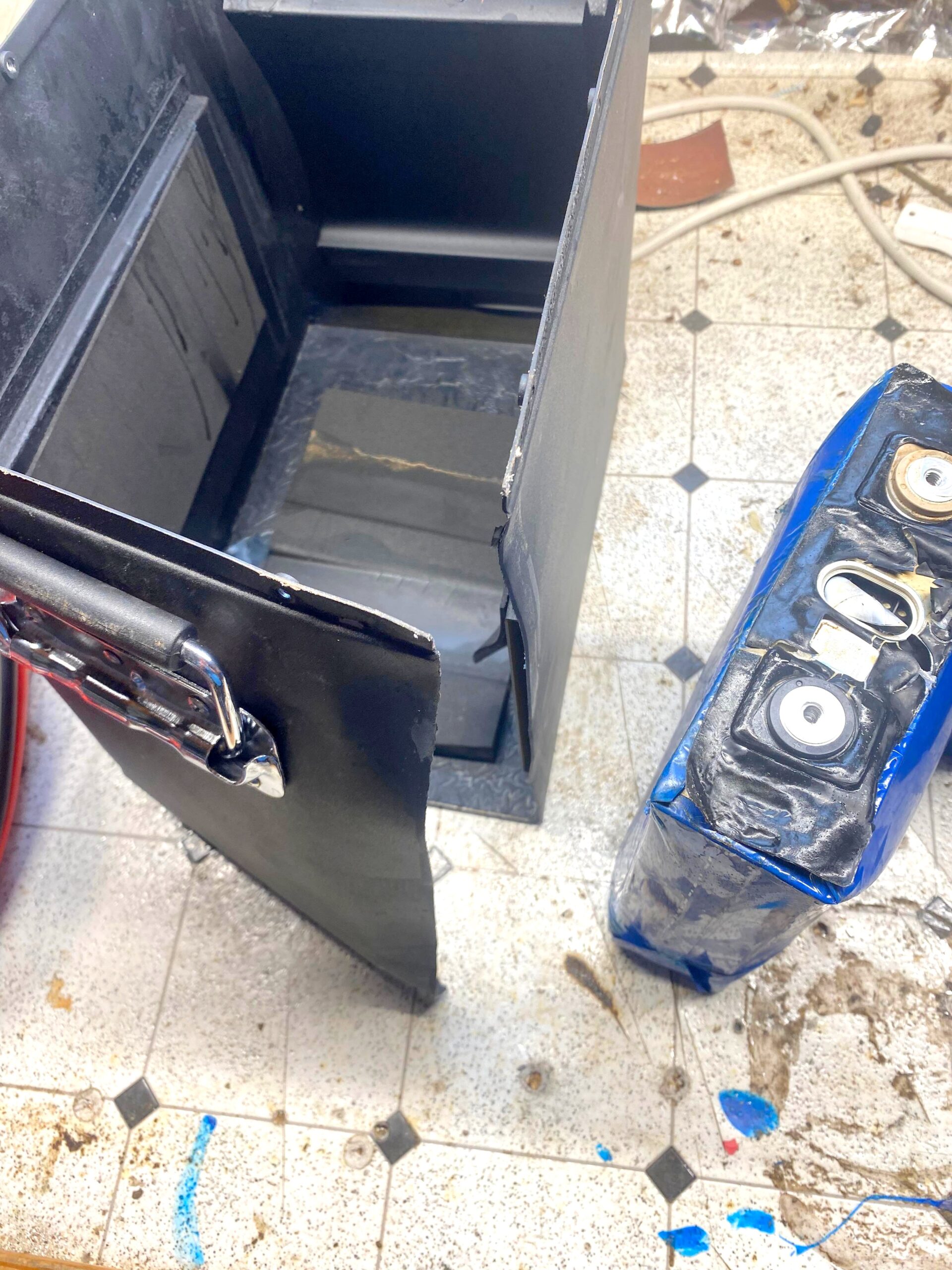
The image below is but one example of the safety of lithium iron phosphate batteries. The cells below came out of a drop in battery where the solar controller failed & the 100V+/- array started feeding hundred+/- volts to the batteries. The BMS tried to protect the batteries but once the BMS shut off. in the solar array was still feeding 100V+/- to the chip in the BMS. Once the chip failed the 100V made it to the FET’s and they too failed allowing the full array voltage to get to the LFP Cells. You can read more about this incident in the July issue of Professional Boatbuilder magazine
No fire, no explosion just swollen ruined cells & cell venting.
You can read about this failure here:
Professional Boatbuilder Article Link
Important Note
This article is not intended to criticize or single out any specific manufacturer. Its sole purpose is to help you become a more informed and educated buyer. Where possible, brand names have been intentionally omitted. I do call out one manufacturer by name, but that’s rare for me—and only done when truly necessary.
Don’t You Just “Drop Them In”?
Installing LiFePO₄ batteries on a cruising boat, while straightforward, is not a plug-and-play upgrade. It really requires a system-wide approach—just like converting from flooded to AGM or GEL batteries. Treat it as a complete electrical system consideration, not just a simple battery swap.
Terminology Used in This Article
-
LiFePO₄ = Lithium Iron Phosphate (also referred to as LiFe or LFP)
-
BMS = Battery Management System
-
C-Rate = Charge/discharge rate based on battery capacity
-
Example: A 100Ah battery at 0.5C = 50A (100Ah × 0.5 = 50A)
-
-
Load-Dump = A BMS-triggered disconnect that cuts the battery off during charging
-
VPC = Volts Per Cell
-
Pack Voltage = Total battery voltage measured across the positive and negative terminals
What Is a “Drop-In” Battery?
A drop-in LiFePO₄ battery is a self-contained unit designed to fit in a standard lead-acid battery footprint—such as Group 24, 27, 31, 4D, or 8D. That’s where the term “drop-in” comes from: it physically drops into the same location as a lead-acid battery.
These batteries always include a built-in BMS. If a battery requires an external BMS—like those used with Victron, Mastervolt, or Lithionics systems—it’s not considered a drop-in battery.
Terminology Clarification
-
LiFePO₄ = A type of lithium-ion chemistry (safe and stable)
-
Li-Ion = Rechargeable lithium battery family (includes LiFePO₄, LiCoO₂, NMC, etc.)
-
Lithium = Non-rechargeable lithium batteries (e.g., CR123 etc., AA & AAA lithium)
Dramatic example of LiFepo4 Safety
The image below is but one example of the safety of lithium iron phosphate batteries. The cells below came out of a drop in battery where the solar controller failed & the 100V+/- array started feeding hundred+/- volts to the batteries. The BMS tried to protect the batteries but once the BMS shut off. in the solar array was still feeding 100V+/- to the chip in the BMS. Once the chip failed the 100V made it to the FET’s and they too failed allowing the full array voltage to get to the LFP Cells. You can read more about this incident in the July issue of Professional Boatbuilder magazine
No fire, no explosion just swollen ruined cells & cell venting.
You can read about this failure here:
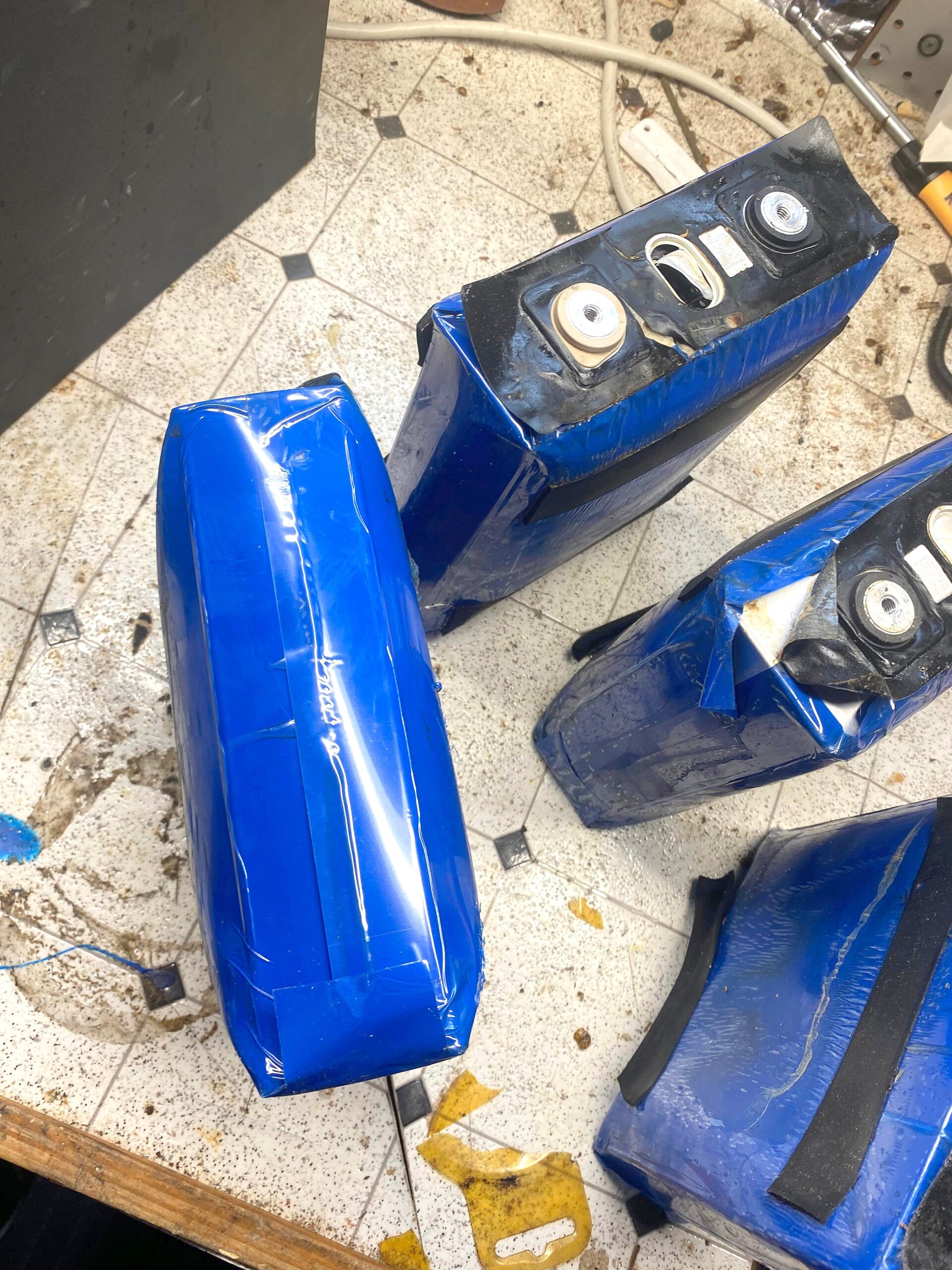
The Cells were overcharged so violently that it blew apart the metal case!
HOW IS A DROP IN BATTERY MADE?
A 12.8 V (nominal) lithium iron phosphate battery is made from four 3.2 V cells wired in series. This is referred to as “4S”. This makes the battery a 12.8 V rated battery. The difference between lead acid and lithium iron phosphate is that each cell in a lead-acid battery is a nominal 2 V cell but in a lithium iron phosphate battery each cell is 3.2 V. So, a 12 V lead acid battery requires six 2V cells and an LFP battery only requires four 3.2 V cells.
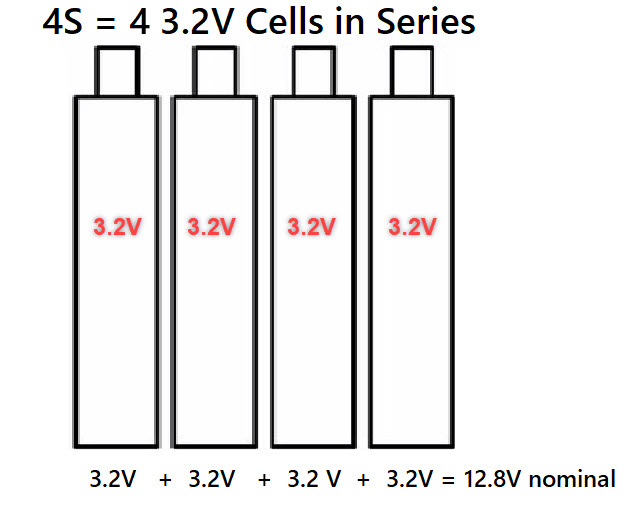
Start with the Cells & BMS
There are currently three primary cell types used in drop-in LiFePO₄ batteries:
1. Prismatic Cells
These are rectangular “brick-like” cells that nest together in a compact block. Prismatics require a cell module that allows for the slight expansion contraction that naturally occurs during charge/discharge while retraining the cells from movement. The quality of the cell module is critical in mobile applications. In China, this compression mechanism is often called a “fixture.” A proper “fixture is essential to maintain long-term performance and safety.
2. Cylindrical Cells
These range in size from a standard AA up to a large D-cell. Their round shape provides inherent structural strength, so they don’t require a fixture. This makes them very durable and well-suited to mobile or marine environments but how the cells are built still plays a major role in the survival of the batts. Some do it well, others don’t.
Clindrical cell packs require a large number of spot welds to interconnect many small cells in parallel before they’re assembled into series strings. This increases complexity and introduces more connection points—but if done properly, it results in a robust and reliable battery.
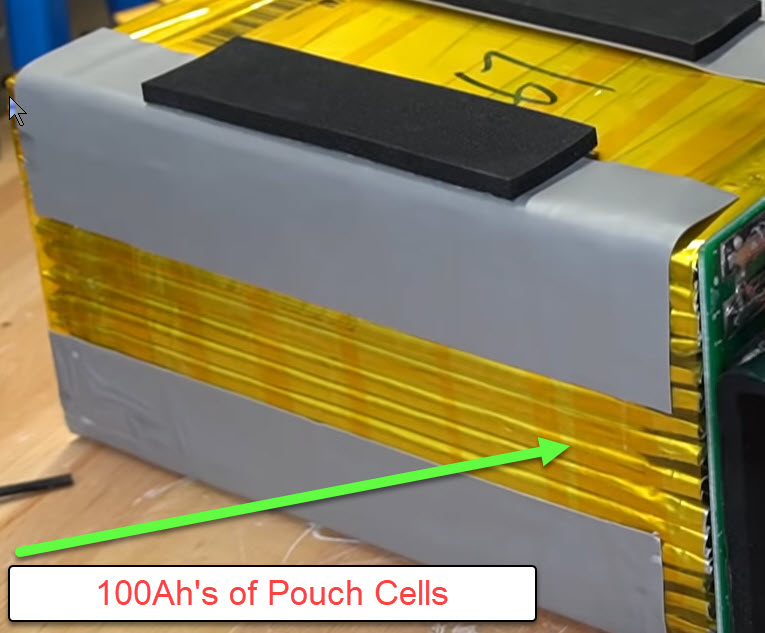
3. Pouch Cells
Pouch cells are flat and flexible, often sealed in a soft foil-like envelope. While they are lightweight and space-efficient, we generally do not recommend them for mobile/marine use, especially where vibration is a factor. Pouch cells can be easily punctured or torn, and they are sometimes placed loosely into aluminum cases that may have sharp edges.
Although modern pouch-cell drop-ins have improved and are less prone to mechanical failure than earlier versions, prismatic or cylindrical cells remain the better choice for high-vibration environments like boats.
PRISMATIC CELLS & BMS

CYLINDRICAL CELLS & BMS
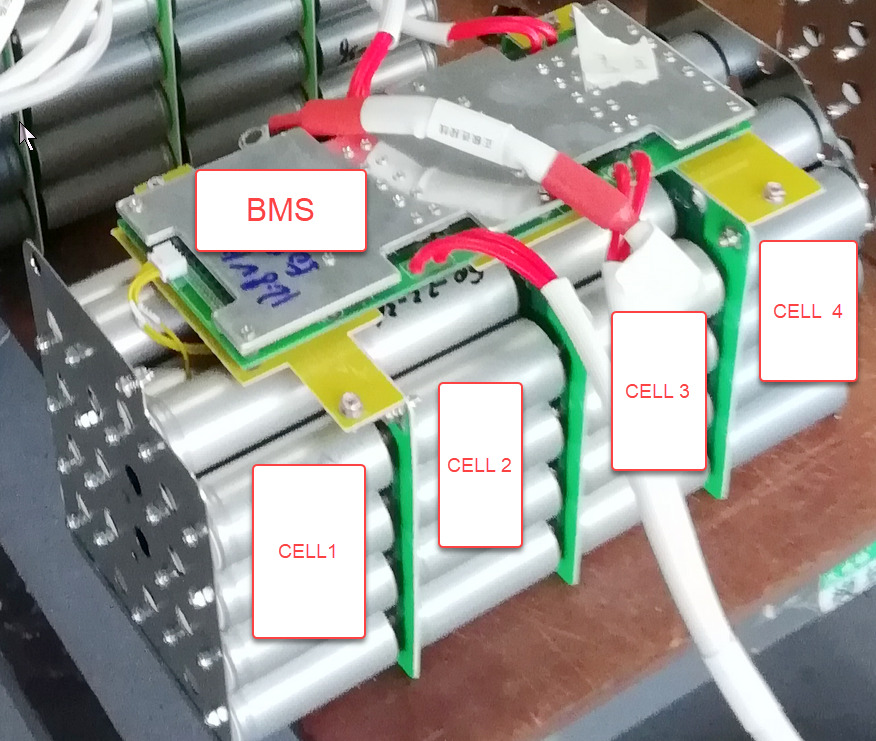
Pouch Cells
ADD A BATTERY CASE

Clearly I’ve left out a lot of the important details of the manufacturing of a drop-in battery. In order to build a battery properly the cells must be impeccably matched before the the cell block is assembled. By impeccably matched I am talking about cell to cell Ah capacity and cell to cell internal resistance. If the cells are not carefully matched the BMS inside the battery may never be able to keep up with the internal passive balancing most drop-ins use..We have seen this in numerous instances with drop-in batteries.
What is a BMS?
BMS stands for battery management system. A battery management system is used to protect the individual cells inside the battery. Each 12.8 V (nominal 12 V) drop-in battery must use a battery management system. You could also call a BMS a cell protection system as it actually serves to protect the battery cells inside the drop-in battery. The BMS will protect the battery cells from such things as temperature, voltage, current, cell balance and over-charging. The BMS protects the battery by disconnecting the battery from the charge sources in the case of over-charging or the loads if over-discharging.. Lead acid batteries do not do this. As of about two years ago “over-charge protection”, also called “Full Charge Protection” began showing up in drop–in batteries. Over charge protection turns off the bank of charge FET’s when the battery is full thus preventing over charging or over absorbing.
Market Growth – Drop-In Batteries
In the last two years the proliferation of lithium iron phosphate(LFP) drop-in batteries has literally gone berserk. Drop-in technology has finally advanced far enough that’s it’s worth discussing in this marine specific article. I had previously avoided this topic because many of the early drop-in products were pretty poorly engineered. Shortcomings such as single channel BMS’ & weak power handling, plagued early drop-in adopters. These short comings are why so many of us early adopters decided to roll our own.
Be Careful Who You Trust
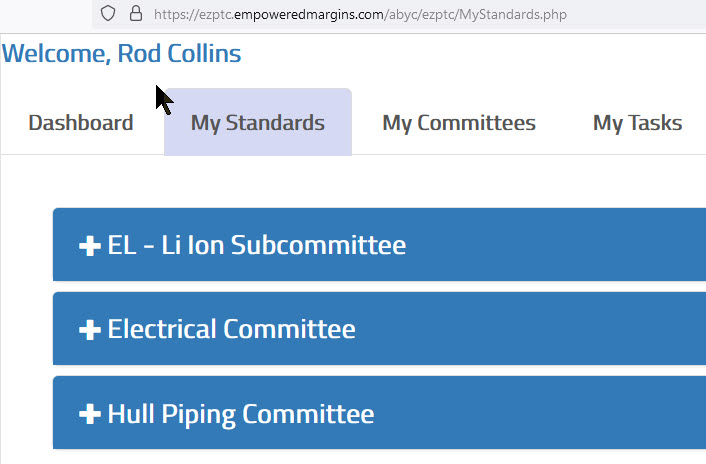
While the internet is full of folks claiming to know what they are talking about sometimes it is easiest to just use a photo. The image below shows the ABYC marine safety standards that I work on. I have been involved with the lithium-ion subcommittee since it was first formed back in late 2013. I was personally invited onto this committee by the committee chair.
How to Avoid Sleazy Vendors
LFP drop-in batteries have come a very, very long way in the last few years, even the cheapest batteries are far better than just three years ago. This does not mean there are no sleazy manufacturers left out there. How do you avoid 98% of the poor LFP products? The short answer is to stick with the most popular brands; eg: Epoch, Wattcycle, Li-time, Ecoworthy, Redodo, SOK etc. These brands have proven track records for standing behind their product.
Don’t Import directly from China on your own!
If you don’t know what I mean by this I would urge you to spend some time on Will Prowse’s YouTube channel but, please don’t focus on his reviews (in a marine application sense), instead focus on how many failures he’s had cutting open & examining drop-in lithium iron phosphate batteries! Please remember that a manufacturer who is sending Will Prowse a battery often knows darn well who he is. They still fail to send him well-built / well executed batteries many of them lacking cold-weather protection (You can’t charge LFP below freezing) even though they frequently lie and tell him the battery has it. If guys like Will Prowse can’t pick quality batteries out of China how can you expect the average Joe to wade through all the murky information and get good LFP drop-in batteries directly from China?
Hey, I’m not complaining, Will has indirectly sent us a lot of paying customers! These customers have had a number of issues with batteries,cells or BMS’s. We’ve made a lot of money testing these batteries in our lab, only to tell the customer they had been sent B-grade or reject cells… This sort of stuff, has been sold as “A”grade” but, the customer got “B” grade or reject products. This scammery runs rampant on Aliexpress, Alibababa, eBay, Bangood etc. etc. so be very careful when ordering direct from China because you’re on your own once you do..!
Purchasing- Rule#1
Rule number one for purchasing lithium iron phosphate drop-in batteries is that you always want to buy from a well established company, with a proven track record.
Currently, all lithium iron phosphate cells are manufactured in China. Some US manufacturers such as Battleborn, claim made in USA but, it is really just assembled in USA of 100% Chinese components. Despite their US assembly, we have never recommended Battleborn batteries as we don’t find their internal construction suitable for a high vibration mobile environment..
Most of the “bad” images you will see below are what happens when a DIY attempts to become the importer of LFP batteries.
What About the ABYC?
ABYC has re-written TE-13 which no longer requires visible/audible alarms among other things. Insurers now have very little they can say about LFP.
“Rod, isn’t the ABYC is a “voluntary” standard?
Absolutely, but here’s the rub, every marina in the United States, and most in Canada, require insurance. If your vessel is insured the insurance company has standards they expect. In North America those standards are the ABYC standards. They use marine surveyors to ensure the boat is safe and up to their underwriting standards. Marine surveyors are currently using ABYC E-13 as a guide for LFP installations and are actively calling out installations that don’t meet the nature of the E-13 document.
An ABYC E-13 compliant installation is what you want to strive for.
YouTube Influencers?
Are They Marine Focused?
Are they Marine Specific Electricians?
I like Will Prowse, he’s the DIY hero of LFP! He’s doing the general public a tremendous service in cutting open all these drop-in batteries and exposing all the dirty little secrets. We too have cut open a slew of these batteries I just don’t do video or video editing well.. The only problem I have with Will is that he does not operate in the marine environment. The marine environment is a different set of circumstances & standards than it is for RV or off-grid cabins. For example, I don’t know a single RV that has a 12V bow thruster that can pull over 600A(no load rating) at 12 V and 1600A+for in-rush LRA/FLA rating. An in-rush like this is capable of ruining some FET BMS boards especially after repeated thrusts. For example, Will, and many others, highly praise Battleborn yet, we have never advised them for a mobile or marine install due to the internal construction, which is just not up to our standards..
“A Grade” = Marketing
Please understand that the term”A Grade” is really a meaningless-term. “A-grade” really means EV/automotive-grade but the Chinese have figured out that people think “A-grade” actually means something…Depending on the seller it may actually mean Abhorrent or Abysmal grade.The top quality cells are EV grade.
For boaters buying drop-in batteries direct from China this can mean the low-grade “orphaned” or “rejected” cells wind up in batteries that may look exactly the same but are sold on Ali-xxxx, , eBay or through other less reputable sources.. Once the cells are sealed in its glued together plastic case you the buyer have no way to know what quality cells you got.
Important BMS Considerations
Current Handling
The current rating of the internal switch that protects the battery is quite often too small for the task on many cruising boats. Drop-in LFP batteries routinely use multipleMOSFET switches as the batteries BMS protection ON/OFF switching. Unfortunately these FET’s often can’t handle the typical loads imparted by many cruising boats. On board devices such as bow thrusters (400A +), windlass’ (100A to 300A+, large inverters 150A to 300A +, electric winches 75A to 300A +, electric cook tops, massive alternators, chargers or large inverter-chargers are very very common on-board cruising boats these days. These are exactly the devices many boat owners are hoping to see a gain in performance from when switching to LiFePO4.
Important: For those going with all electric boats eg: air conditioning, electric range and massive inverters we suggest not discharging any FET battery at more than 70% of the “continuous” rating. We also do not advise charging any passive ballancing FET BMS battery at more than .2C. Following these two basic rules will ensure your BMS lasts…
What a FET BMS Looks Like
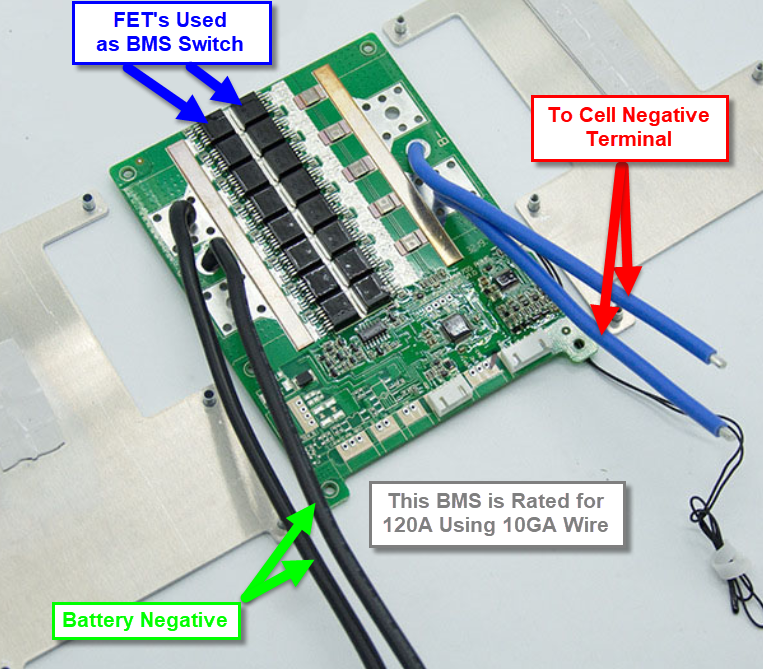
FET QUALITY MATTERS
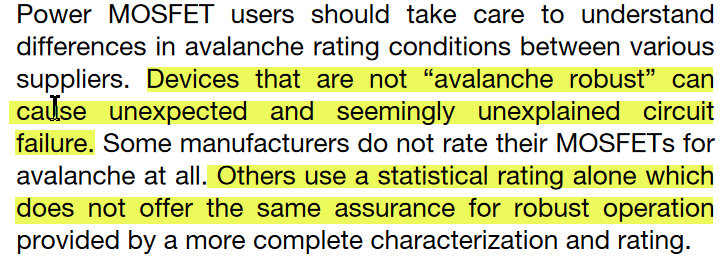 High-Current DC Devices?
If you own a vessel with high load devices, do yourself a favor and read the BMS specs very carefully
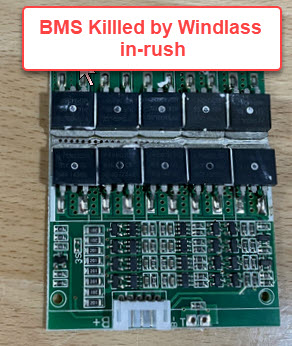
A Dead 2014 single channel FET BMS (windlass in-rush)
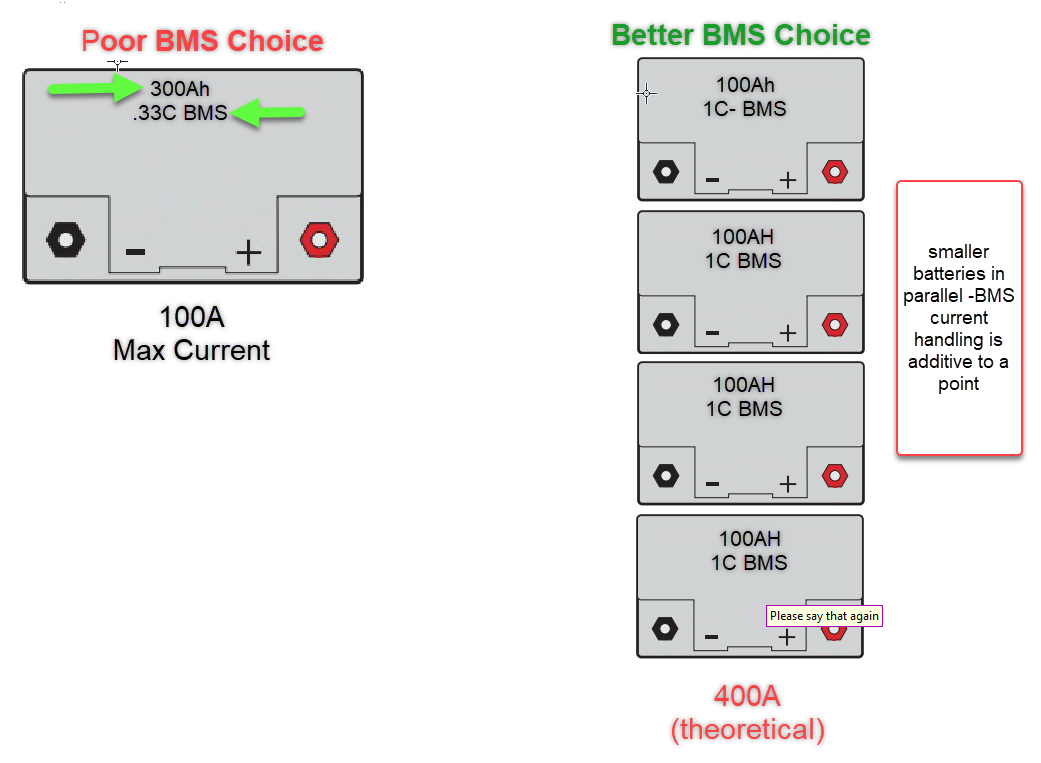
Assembling a Drop-In Bank for Large DC Loads
When it comes to FET based BMS batteries we typically advise smaller individual batteries, wired in parallel. This is done to share the load across the FET based BMS’s. For example three 100Ah / 1C rated LFP drop-ins can handle a 300A discharge, if the parallel wiring is perfect and all batteries share the load equally. A 300Ah 8D format drop-in, like the one addressed below, can really only handle a 100A (0.33C) discharge. When in doubt with FET based BMS systems smaller batteries in parallel are often a better solution than one large battery with a low current rated BMS.
A Drop-In Battery Spec sheet SHOULD Look Like This
*Highlighted specifications are the critically important ones.
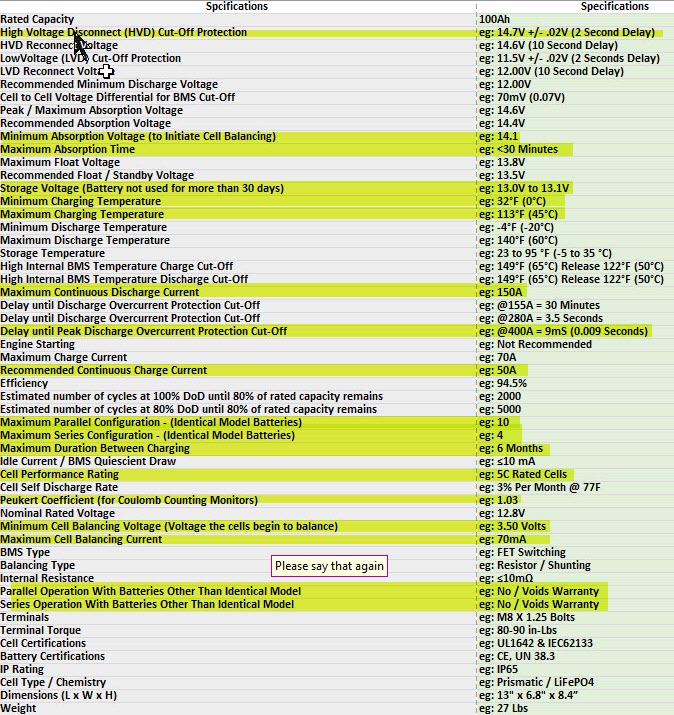
Minimum Absorption Voltage (to Initiate Cell Balancing): This is important because you need/want to activate balancing with each charge cycle. You also want to avoid pushing to the maximum charge voltage every cycle if you wish to maximize cycle life.
|
High Internal BMS Temperature Discharge Cut-Off: same as above but for discharging.
|
Vibration
Some of the very cheaply sourced drop-ins are using 18650, 26650 or 32650 cylindrical cells inside the battery case. In a worst case, a 100Ah LFP battery, built from 18650 cells, would need a grand total of 91 cells with two connections per cell.
If you cell module is put together with tape and foam, not uncommon, it’s the wrong design for a mobile application-
DC Motor In-rush
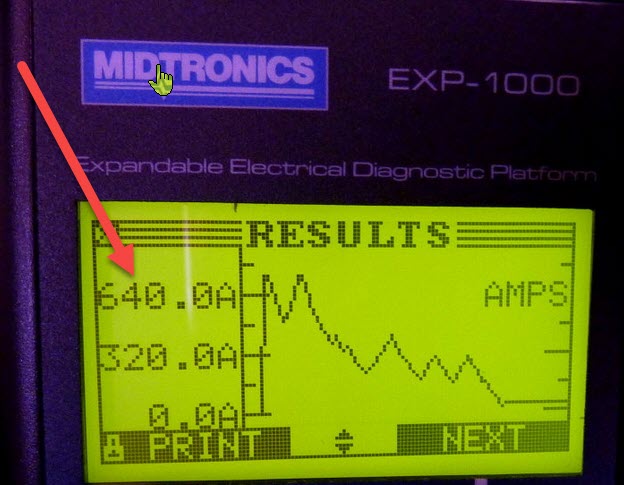
The reason most drop-in batteries cannot be used for starting is the in-rush current. The in-rush of large DC motors looks like a dead short to the FET’s. Imagine sitting there and intentionally shorting your battery multiple times each day? That is what starting your motor, running a windlass, electric winch or Bow thruster looks like to the FET’s. There are LFP batteries that can be used for starting but they are very expensive at this point in time.
Starting a 40HP Westerkeke takes=640A!!!!
Cylindrical-cell battery failure
Cylindrical cells are great performers but like anything the devil is in the details. Do you know how well your battery is put together? Battleborn uses cylindrical cells and their construction is not something we advise for mobile applications.
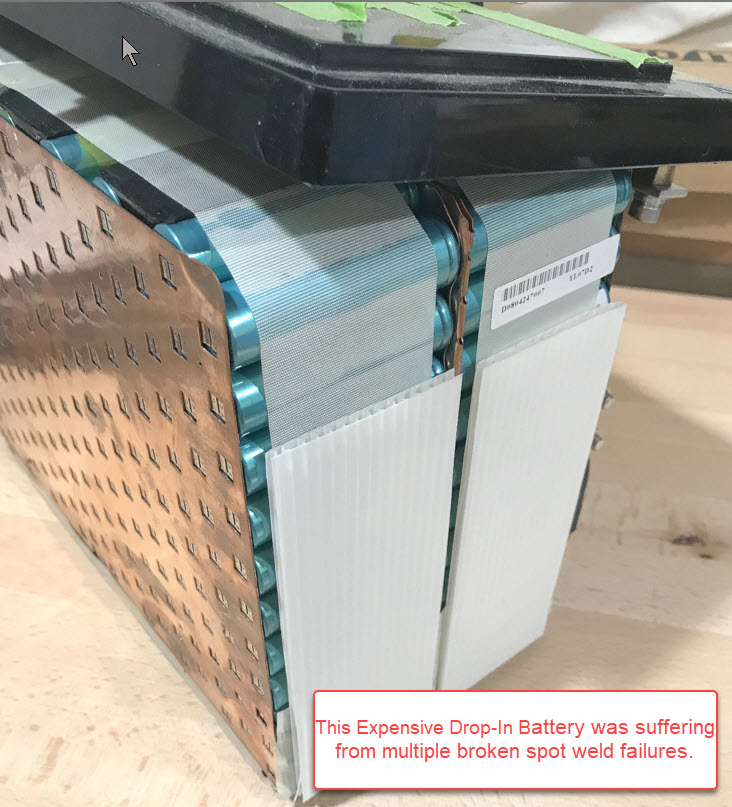
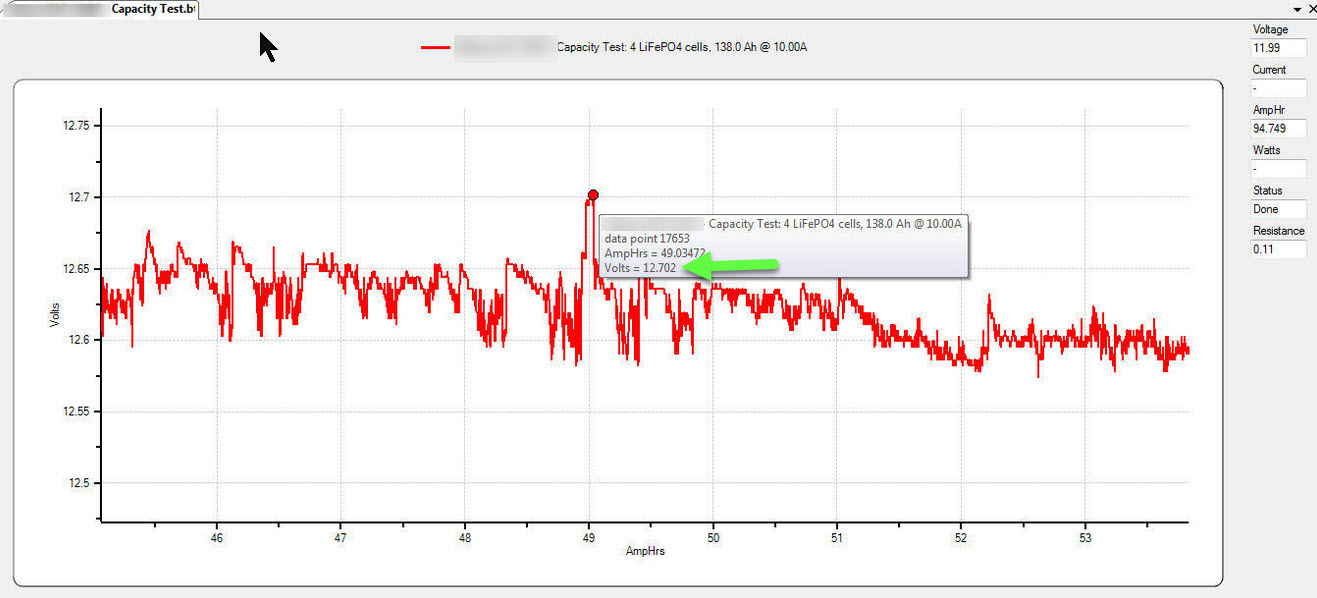
How did we discover the spot weld failures? The zipper like discharge graph was a dead giveaway.. After a discussion with the manufacturer we had to tell the customer to stop using his bank immediately…It had also lost significant capacity from over charging. His lead-acid charger that held 14.6V way too long 4 hours on every cycle. We were testing them for capacity when we discovered the spot weld failures (brand purposely obscured). In the screen grabs below you can see how varied the voltage was on discharge.We had wanted to run the discharge at 40A but the zippered graph was even worse at 40A so we ran the capacity test at 10A..
Data point =12.582V
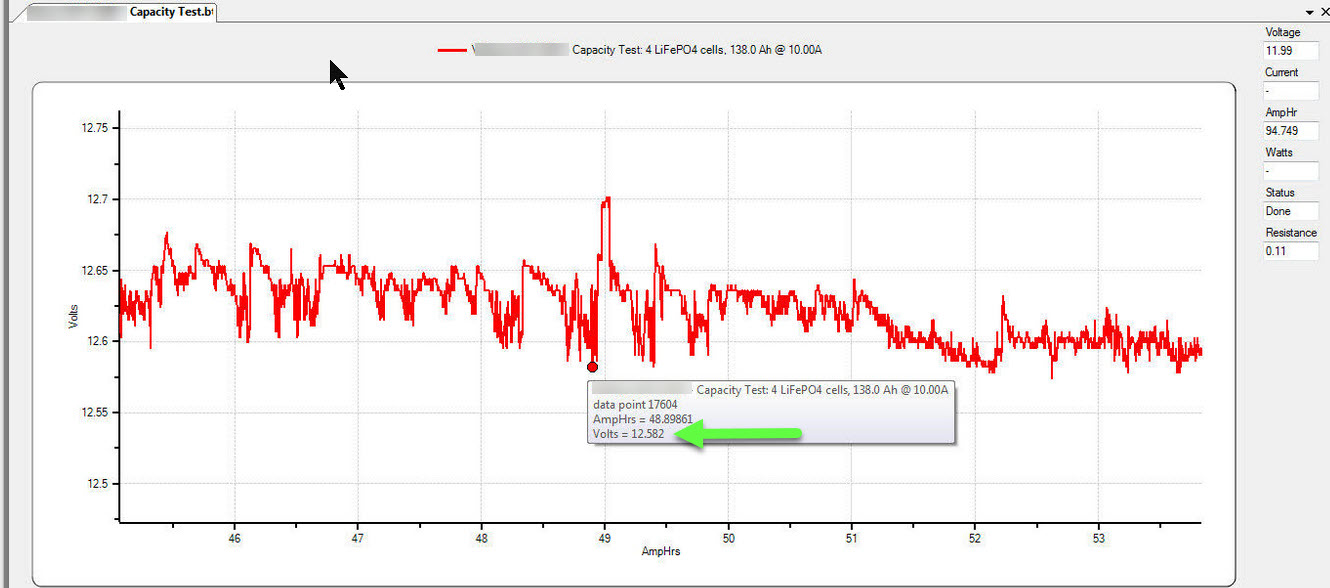
Data point = 12.702V
 Internal Wiring Shortcuts
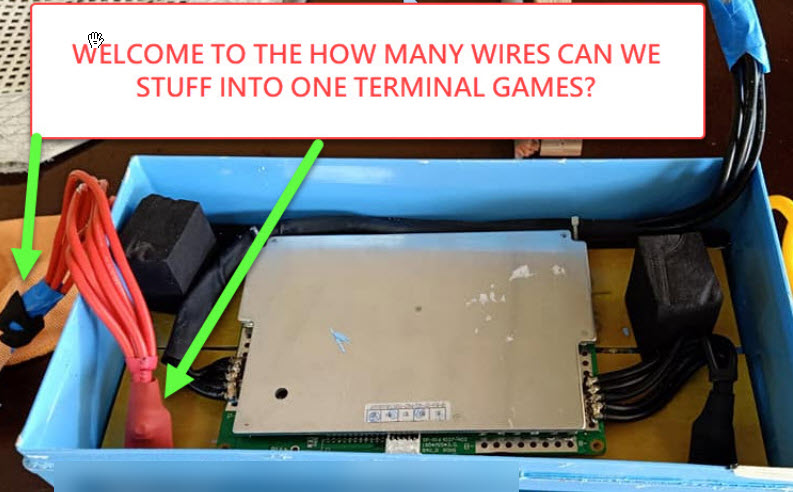
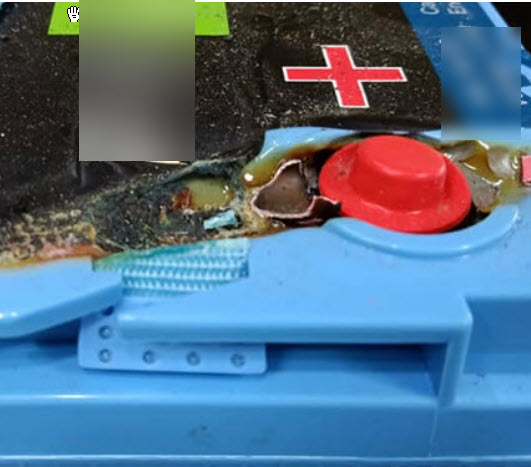
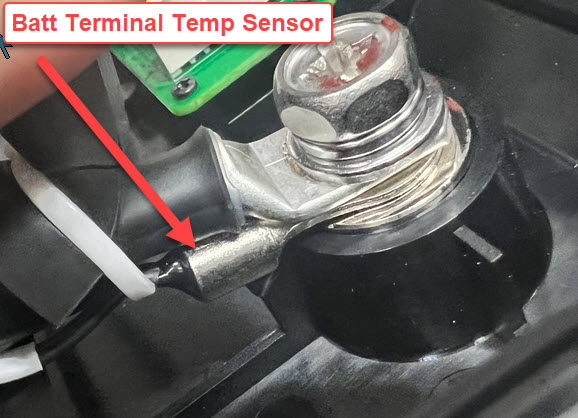
What happens when you cram multiple small wires into one terminal and ask them to carry 100A +/-Hint: You get terminal melt down.. Epoch batteries has a positive & negative terminal temp sensor to identify high resistance before it starts a fire. FWIW, this is one of the most expensive batteries on the market!Price does not guarantee quality.

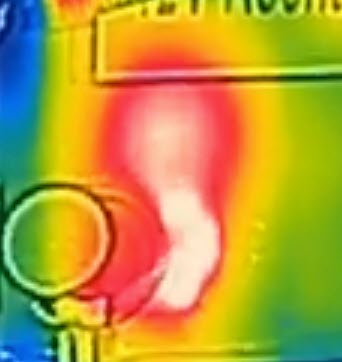
Here’s what they look like when you hit them with thermal imaging.
The Internet said LiFePO4 is 100% safe
No battery chemistry is 100% safe, especially when you over charge it, however no-fire , no-flames & no explosion just cell swelling and heating… FWIW this “starting battery” has zero BMS Protection. A BMS is required under ABYC and ISO.
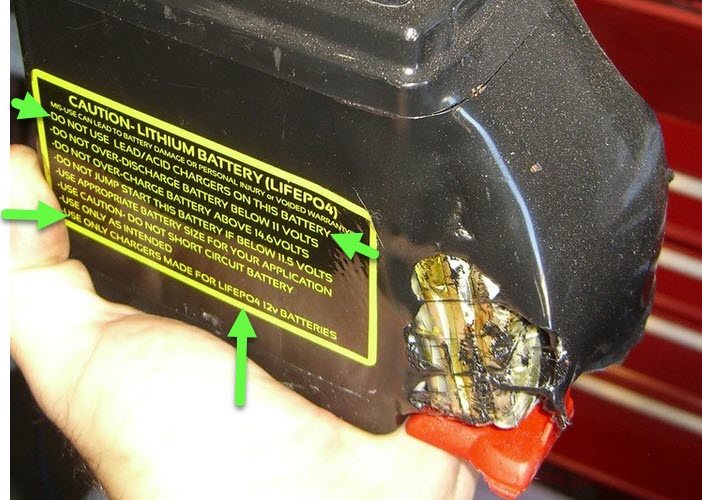 Image courtesy MHT Reader
Prismatic Cell – Over-Charged
This is what over charging looks like, but again no fire, no explosion.
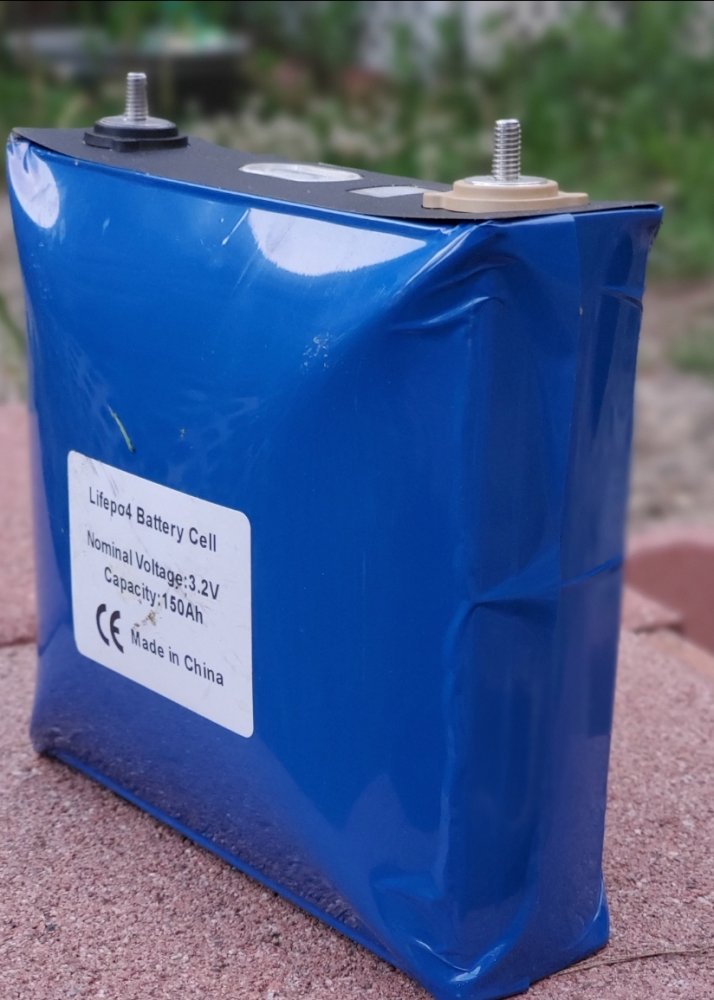
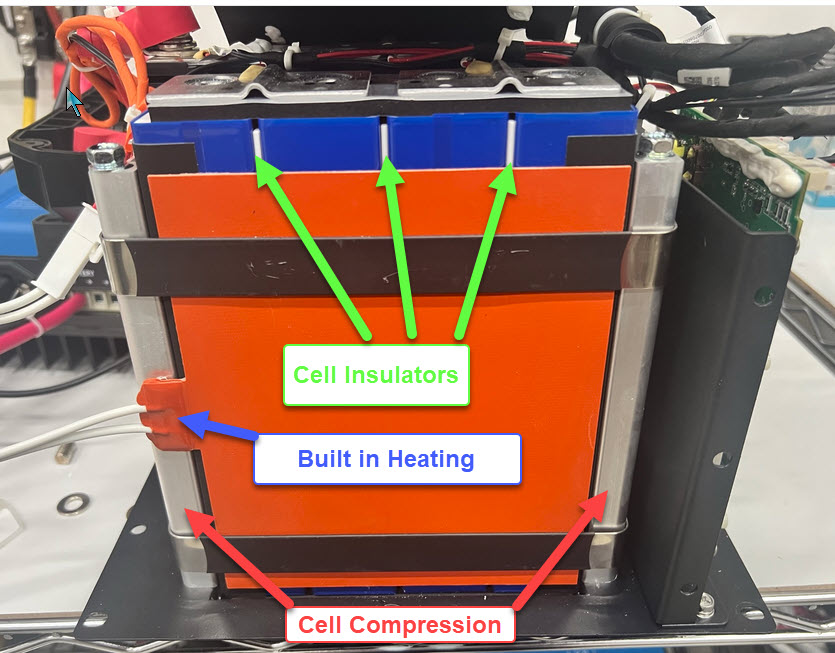
Cell Module/Containment
Below is what proper cell module looks like (Epoch). Has your chosen manufacturer included this? Lots of manufacturers use thin-wall aluminum cells just dropped into a plastic case and dead space taken up by foam & tape.. For a mobile environment the cell module is the most important feature. A good design will prevent the cells from moving while allowing for the small expansion /contraction of the cells during charging & discharging.
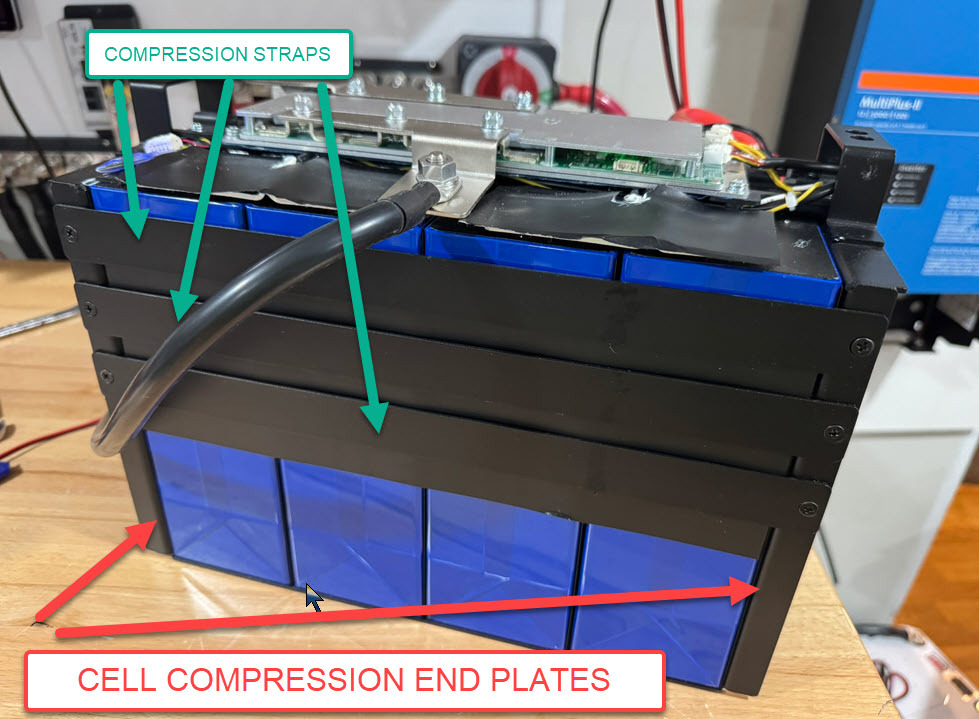
What Good Quality Looks Like
Price does not always = quality. The cell module below is from one of least expensive batteries, a Wattcycle 314Ah mini.
Epoch
For the price and feature level these batteries simply cannot be beat. The image below shows a feature that goes far beyond any brand we’ve seen. Epoch puts a temp sensor on the positive and negative terminals to protect the battery if there is a high resistance connection.
Internal Wiring
It is not uncommon to open a 100Ah drop-in battery, rated at 1C, and find a single 10GA or 12GA wire feeding the main positive and negative terminals. When someone finds a 10GA or 12GA wire rated for 100A, under any safety standard, please let me know?
BMS Shortcomings
Lack of low or high-temp Protection
Some of the drop-in batteries may lack BMS temp protection altogether . Drop-in batteries should have both low and high temperature protection (a requirement for both ABYC and ISO) but many don’t. Far too many drop-in batteries lack low temp protection and a large number of manufacturers who claim it has low temp protection are actually lying about it. If You live up North, buyer beware!
WHAT ABOUT CHARGING?
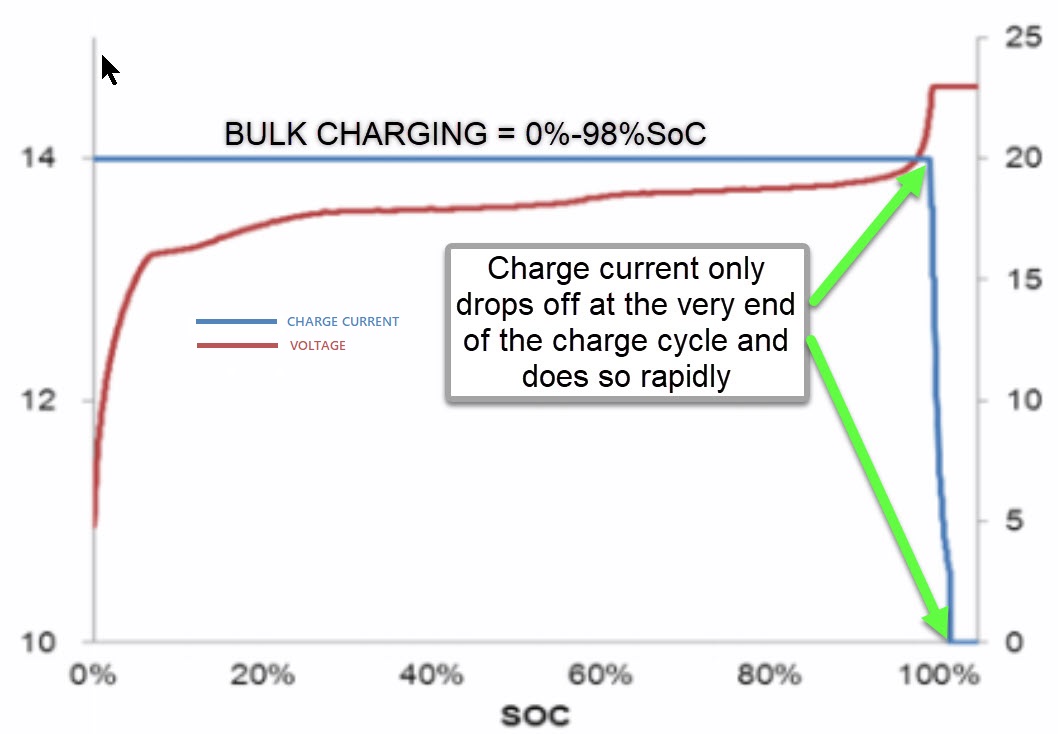
LFP batteries are charged using a CC/CV profile. This means constant-current/constant-voltage
Bulk = Constant-Current(charge source working flat out or as hard as it can)
• Absorption = Constant voltage( voltage is held steady for a short time or until current declines to the manufacturers spec.
• Absorption Duration = Once the batteries have achieved the absorption voltage the time the batteries spend at this voltage must be limited. Many lead acid charge sources spend far too long in absorption and this is not healthy for LFP
BMS LOAD DUMPS
These are very rare today. Now that most all drop-in batts utilize dual-channel BMS boards. This just means the BMS can turn off charging but still remain connected to the loads. Early Drop-in batts used single channel BMS boards so any irregularity would cut-off the entire battery leading to major problems. We still advise a spike protector also known as an APD (Sterling Power), APM (Balmar) or the Alternator Shield (ARCO).
Reader email: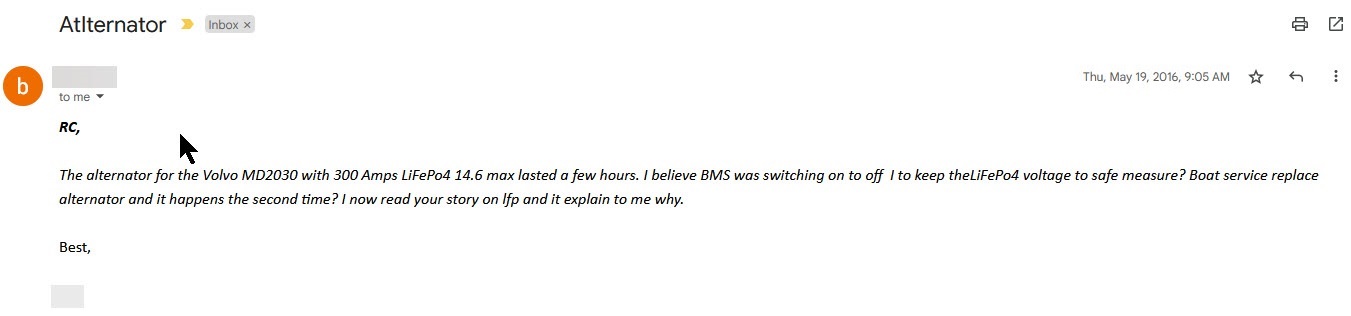
Unfortunately the reader above learned the hard way and these were early drop-ins, circa 2015. Ask yourself what happens when your alternator is in bulk charge, supplying all the current it can, and the internal BMS decides to “open circuit” or disconnect the battery from the boat? I’ll help out a bit here. Lucky for us, load dumps are now very rare in dual channel BMS batts.
BMS Load Dump Illustration–(Single Channel BMS)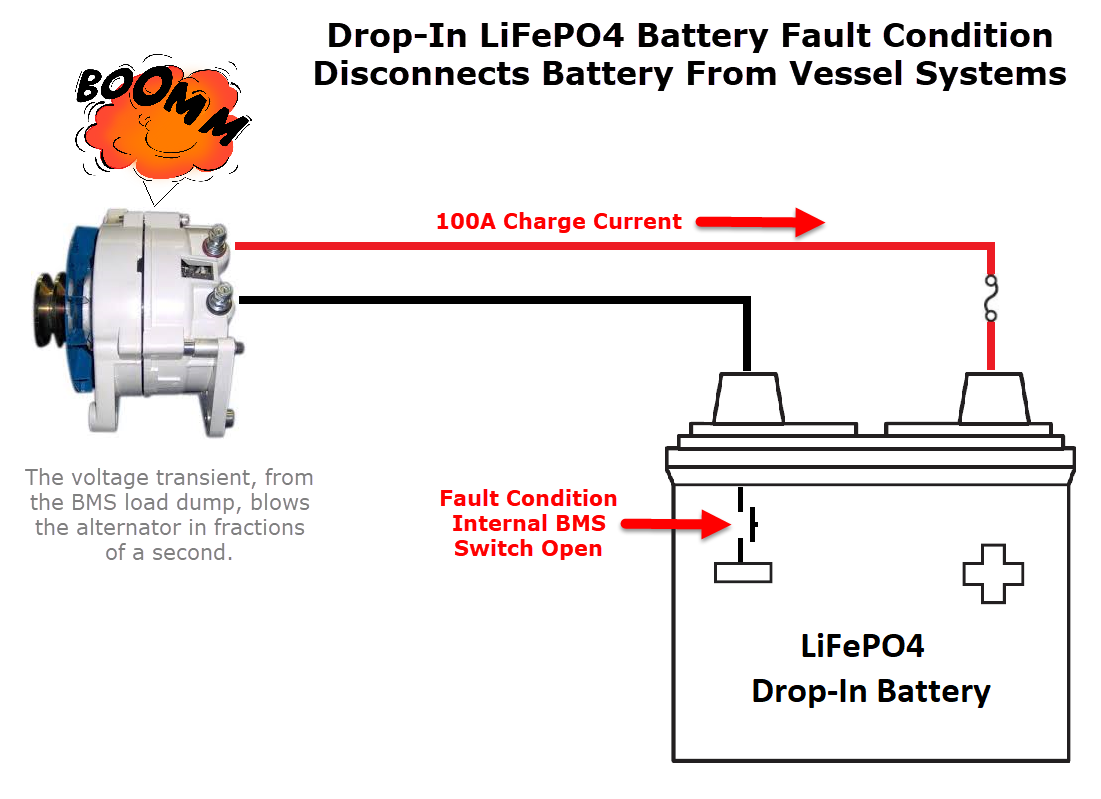 What a Load Dump looks like
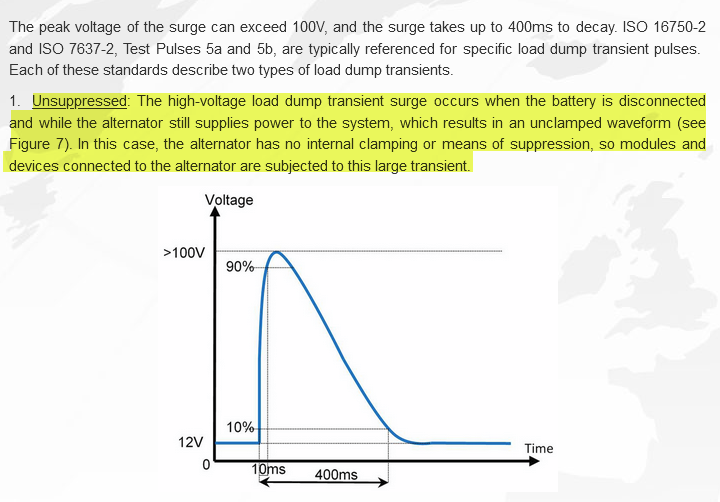
The load dump transient captured in the above image is from an ISO test of a 12 V automotive alternator. Of important note is how quickly this transient surpasses 90V.
Surpasses 90V in just 0.01 seconds
TIP:
At a bare minimum, every drop-in LFP battery bank, that can be charged via an alternator, should be installed with an Alternator Protection Device. We like the Sterling APD , the Balmar APM and the ARCO Alternator Shield.
Buy a Sterling Power Alternator Protection Device
Buy a Balmar Alternator Protection Module
Why Batteries Shut Down
The number one reason we see batteries shut down (when everything is programmed correctly) is almost always due to BMS temp related issues not necessarily high cell voltage.. When dual-channel FET BMS’ started showing up in 2014 or so load dumps became pretty rare because they can shut off charging but still remain connected to the load. If the load is big enough it just absorbs the spike. Prior to about 2014 dual channel BMS’ were very rare, hence the load dump concerns.
Mitigating Load Dump Damage
A good technique to mitigate load dumps is to keep a buffer “load” on the charge bus at all times (Buffer load = lead acid battery on the systems charge bus (see the Victron ARGOFET Isolator wiring below). With FET isolators, we like to see them at least double the rating of the alternator eg; a 200A ARGOFET for a 100A alternator. The cooler FETs run the longer they last. And yes, we have seen FET isolators fail…
Buy Victron Argofet – Bay Marine Supply
Load Dump Protection Work-Around’s
Using Low Volt-drop FET Isolators with an externally Regulated Performance Alternator
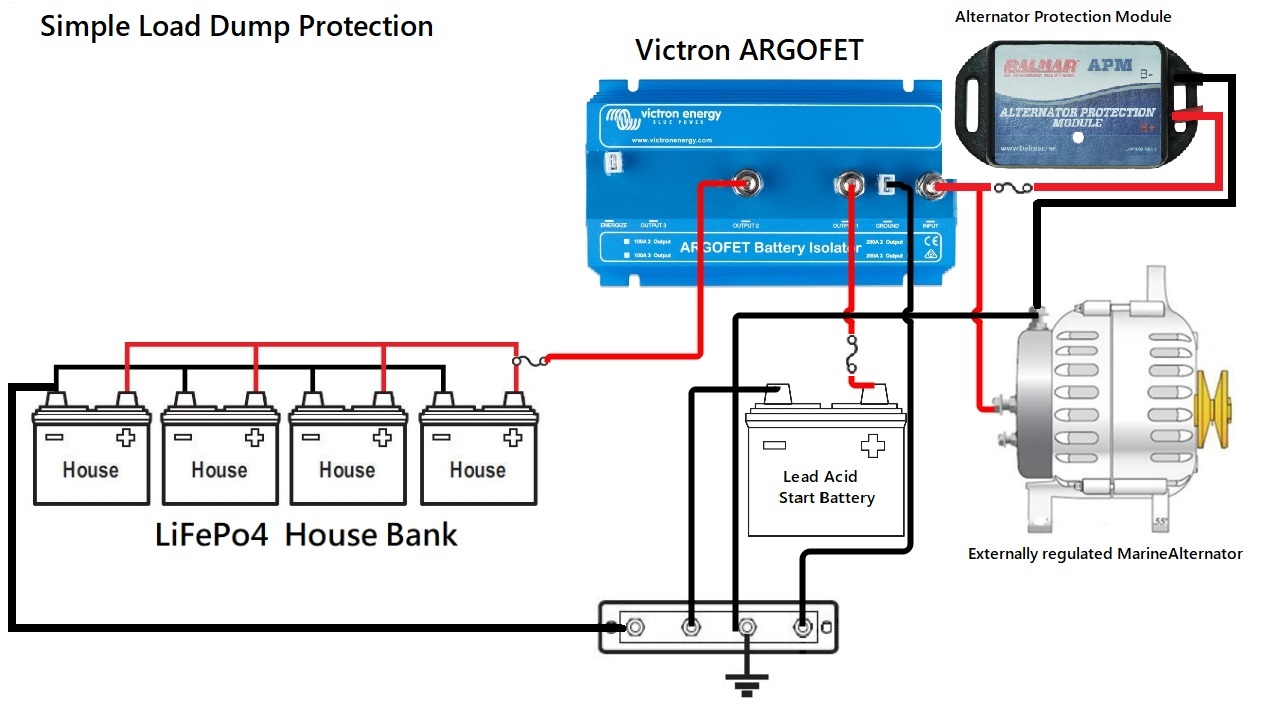
USING DC to DC CHARGERS
There are many benefits to using DC to DC chargers. One of those benefits is that the charge profiles can be custom configured to charge LFP batteries where your factory alternator or legacy lead-acid charge equipment cannot be programmed for this. The Victron Orion TR Smart and Sterling power DC to DC chargers can also absorb a load-dump from a BMS disconnect where your factory alternator cannot.
Sizing a DC to DC charger
Caution needs to be used when sizing DC to DC chargers. A DC to DC charger should be ideally be sized at approximately of 50% of the factory alternators rated output. This means if you have 100 amp factory alternator the maximum DC to DC charger you should use is 50A. This will help keep the alternator cool and keep it from burning itself up. Currently there are only two DC to DC chargers we recommend and those are Sterling Power and Victron.
The only drawback to using DC to DC chargers is that you give up charging your LFP batteries quickly. Seeing as that is one of the major benefits of LFP batteries we would strongly advise considering an externally regulated alternator with an external regulator such as the Arco Zeus, or Wakespeed WS-500 these regulators can be programmed for LFP and have an alternator temperature sensor to protect the alternator from heat damage. This will also result in considerably faster charging!
CAN I USE MY STOCK ALTERNATOR?
The short answer is, we do not advise this for charging lithium iron phosphate batteries directly. You can however use your stock alternator if it is behind a DC to DC charger that serves to protect it.
WHY?
1- A stock alternator rarely has the correct charging voltages for lithium iron phosphate batteries.
2-They can over absorb the batteries resulting in over-charge which eats into cycle-life
3-The absorption voltage is very often too high
4-Stock alternators do not FLOAT, they only do bulk and absorption.
5-Alternator heat damage
Do You know the voltage set point of your stock alternator?
We have been an alternator manufacturer for more than 15 years so we understand internal vs. external regulators and how these alternators are built. We also have access to data, such as you’ll see below. This is data the average DIY would never have access to.
Max Charge for a 12V drop-in battery is 14.6V or Lower.
Common Internal Voltage Regulators
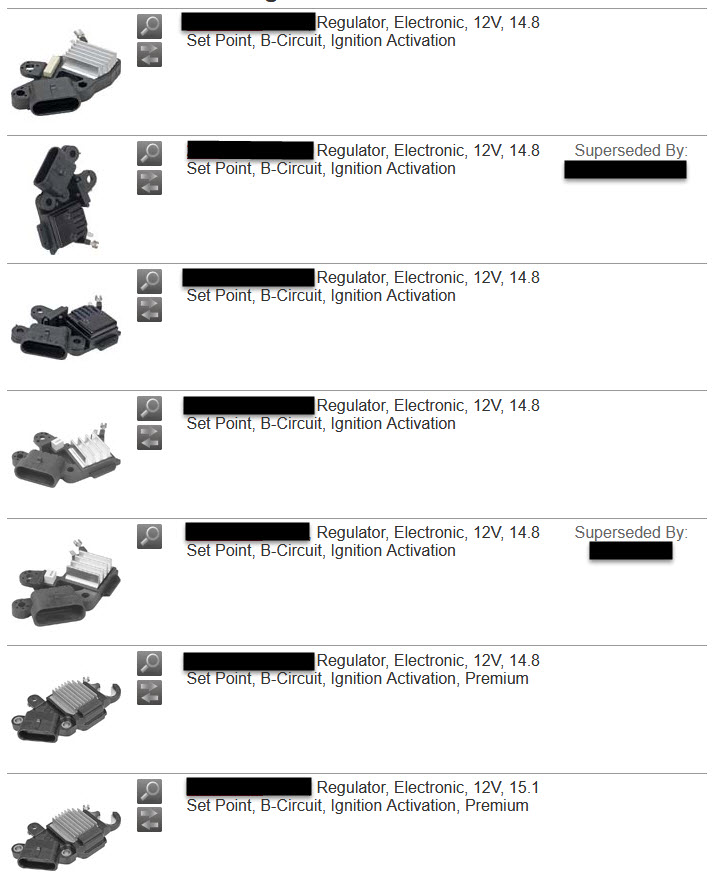
Alternator heat damage
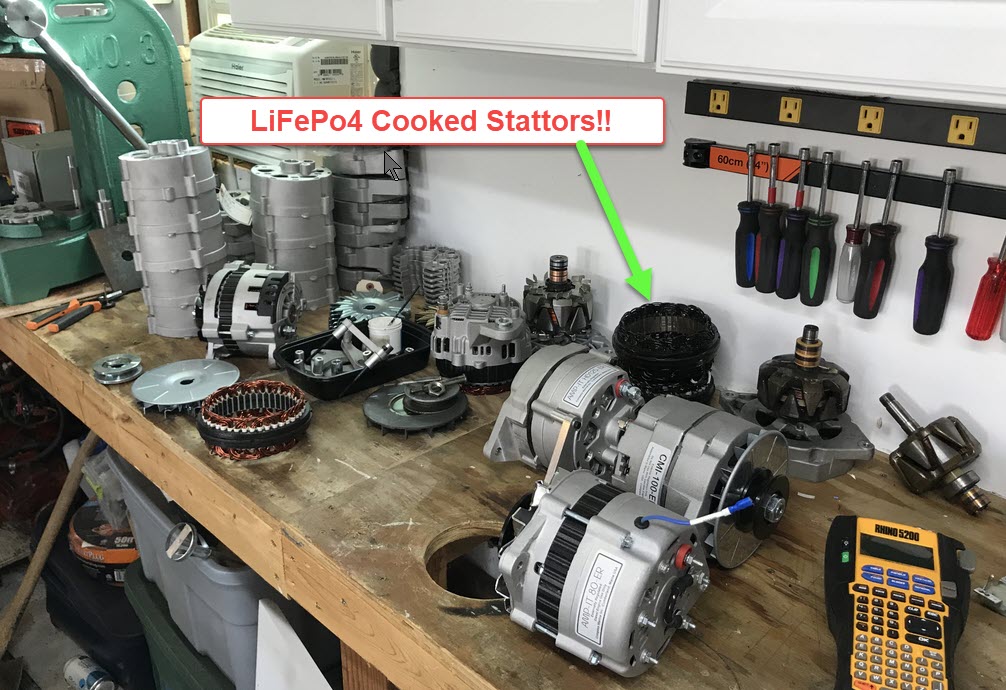
LFP batteries have a tendency to enjoy eating alternators for lunch as do large AGM banks. The internal resistance of LFP batteries is extremely low resulting in very long bulk-charging times. As a result alternators can burn themselves up trying to charge these batteries.
Because Compass Marine inc. was a manufacturer of marine alternators so we got to see these failures regularly. We are not an n=1 data point like the “dude on the internet” who says your stock alt will be fine charging LFP. We have seen far too many alternators completely melted down by LFP batteries to ignore this information..
If you insist on using your stock alternator we would strongly recommend that you put it behind a DC to DC charger (50% smaller than your alternator amperage rating. This will help limit the amount of work the alternator is doing and protect it from a meltdown.Doing this means you can continue to use your stock alternator.
If you expect to charge lithium iron phosphate directly from the stock alternator without a DC to DC Charger in-between, we advise not changing a thing. Do not increase the wire size to the battery bank ,do not move the volt sense a wire do not touch the factory wiring . Doing so can result in an alternator meltdown. The typical factory wiring on these alternators is horrible and results in a lot of voltage drop. That, in and of itself, can help protect your alternator from melting down.
Why does LFP cause heat damage?
It is very simple your alternator never catches a break!
Our Alternator Assembly Bench on a Typical Day..
Stock Yanmar/Valeo Alt Cooked
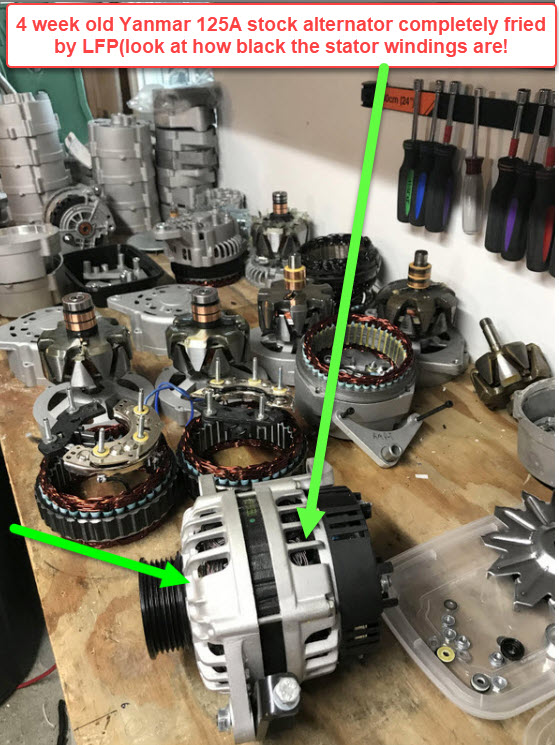
Yanmar/Hitachi alternator Cooked

Burned up Stator From Charging LFP
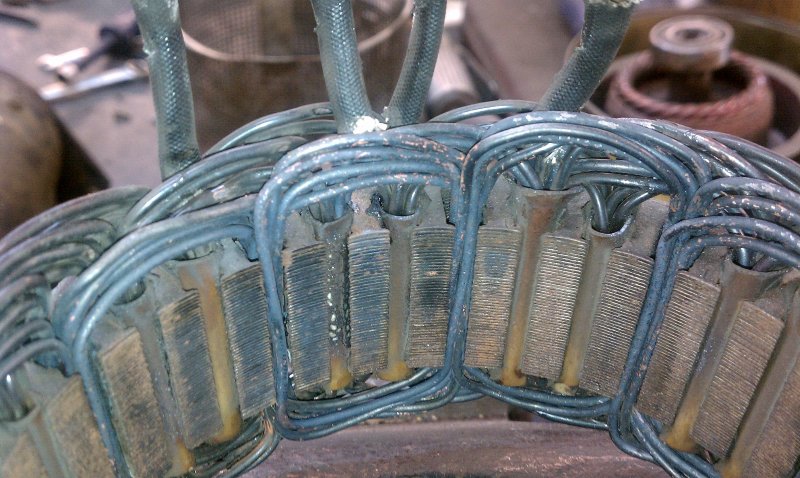
Another One
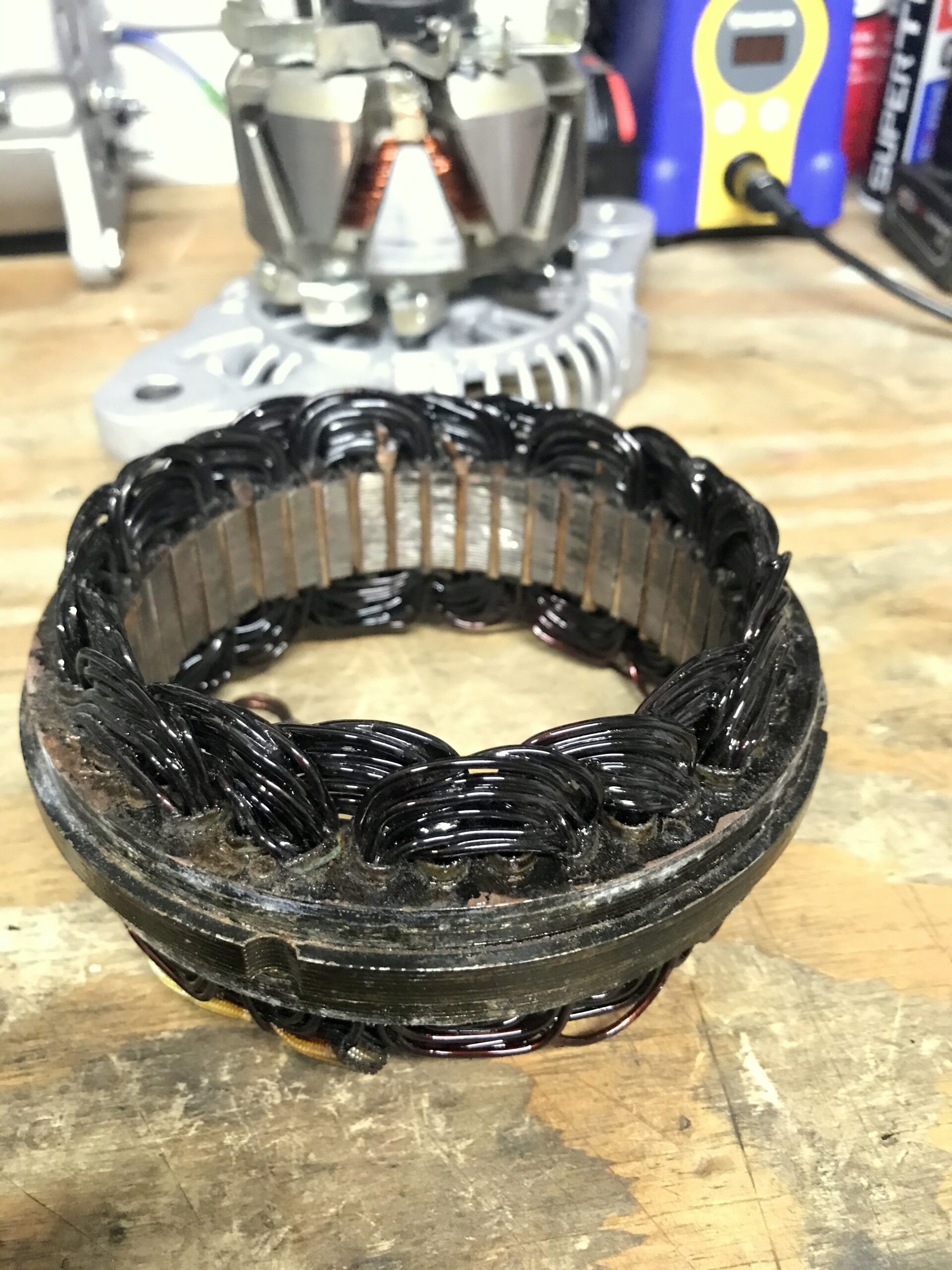
Another LFP Cooked Alternator

But, Ample built good alternators?
Yes, they did but during this vintage Ample Power did not believe in using an alt temp sensor on their regulators.. When LifePO4 came around…This alt ran fine for 20 years charging lead acid. Within weeks of converting to LFP, toast!
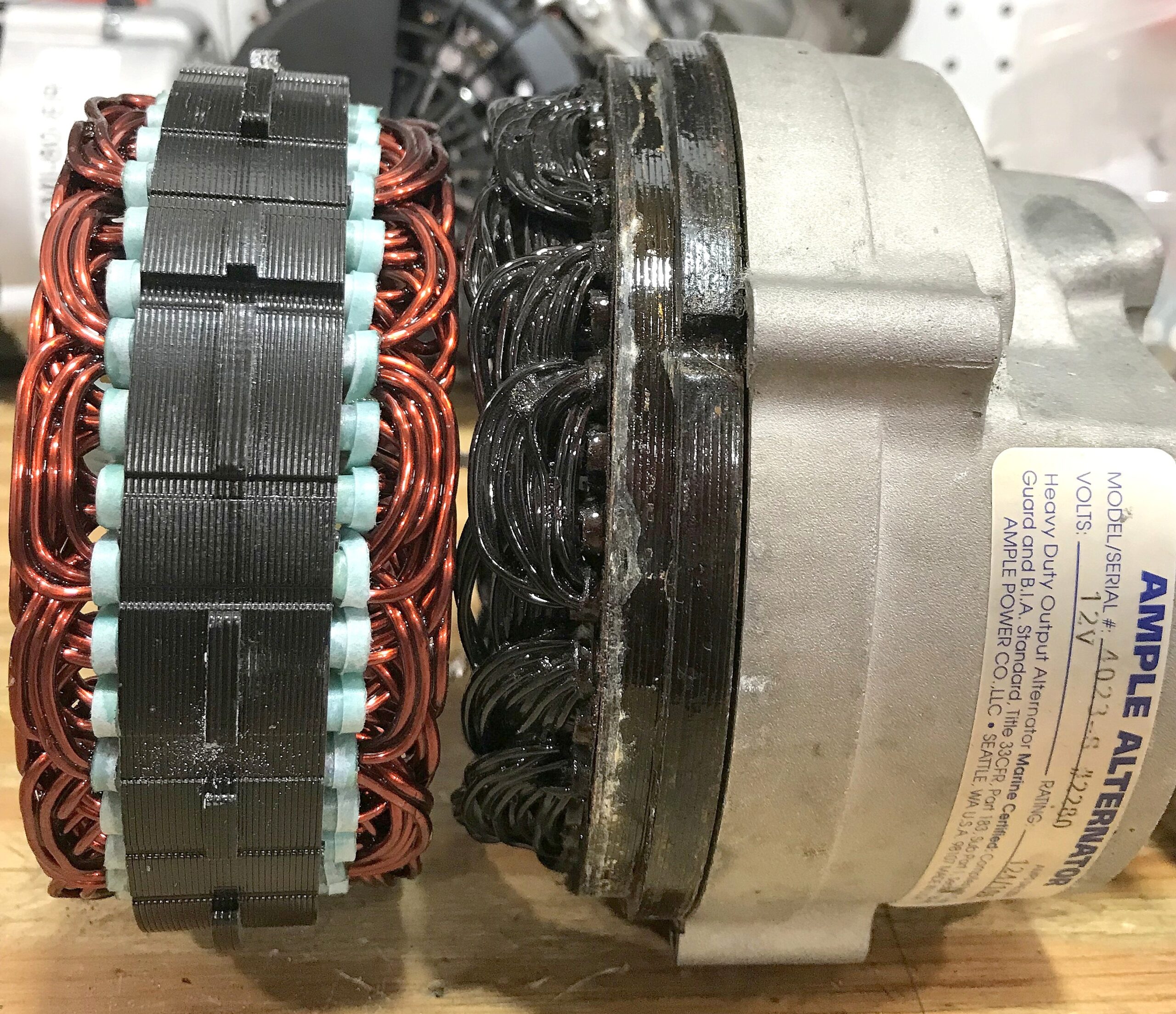
CHARGING LFP WITH OTHER SOURCES
LFP batteries are charged using a CC/CV profile. This means constant-current/constant-voltage
Bulk = Constant-Current(charge source working as hard as it can see burned up alternators above)
• Absorption = Constant voltage( voltage is held steady for a short time or until current declines to the manufacturers spec.
• Absorption Duration = Once the batteries have achieved the absorption voltage the time the batteries spend at this voltage must be limited. Many lead acid charge sources spend far too long in absorption and this is not healthy for LFP.
Do you know what this means?

max charge voltage 14.6V
max charge current 20% of installed Ah Capacity
When at 14.6V all charging must stop when accepted charge current has dropped to 0.02C or 2% of installed Ah capacity
Can Your existing charge system do this?
Pay Attention to Small Details

When installing these LFP batteries in parallel the max charge voltage is just 13.8V-14.2V (it’s 14.6V for a single battery “small details”)
Max charge current is 50% of installed Ah capacity or .5C.
When at 13.8V – 14.2V and charge current has fallen to 5% of installed Ah Capacity all charging MUST STOP
Can Your chargers do this?
 Can Your charge sources be programmed for these parameters?
Series Solar Warning!
Over the last few years on boats one of the trends that can be a little terrifying has been that solar panel array voltages have been creeping up and up.. Many boat owners want to install their solar panels in series and then run them through an MPPT controller to maximize the energy capture of the array.
This is all well and good until there is an issue and the MPPT controller fails. Imagine what happens if you’re MPPT controller fails and starts passing PV voltage through to the batteries? If your array is over 60V & these are lead acid batteries they will eventually explode. If they are lithium iron phosphate drop-in batteries you will toast your BMS! Once the BMS is been fried by the solar array voltage you have no BMS protection & the solar array will continue feeding dangerous voltage to the batteries until they are destroyed. You can imagine what will happen if this continues to go on after in an MPPT failure. In case you’re wondering yes, these failures have happened and lithium iron phosphate batteries have been destroyed due to this. These failures almost never occur in tier-top tier supplier MPPT’s.
How do you avoid this?
#1-observe the maximum number of series batteries you can wire for. With most brands limit this is 24 V or 48 V. This voltage is typically the maximum SAFE voltage the battery bank BMS CAN handle. So, your PV array should not exceed this voltage.
#2 if you wish if you wish to use series-solar on your vessel you will be safer to split the array into smaller series strings that remain below the batteries maximum series allowable voltage and give them each their own MPPT solar controller.
#3 Use only top tier MPPT suppliers (eg; VICTRON, OUTBACK, MIDNITE, MORNINGSTAR ). These controllers use isolated input/output and are designed not to fault in a manner that passes full PV voltage through to the batteries..
Pack Voltage vs. Cell Voltage
Pack voltage tells you nothing about cell voltage as can be seen below!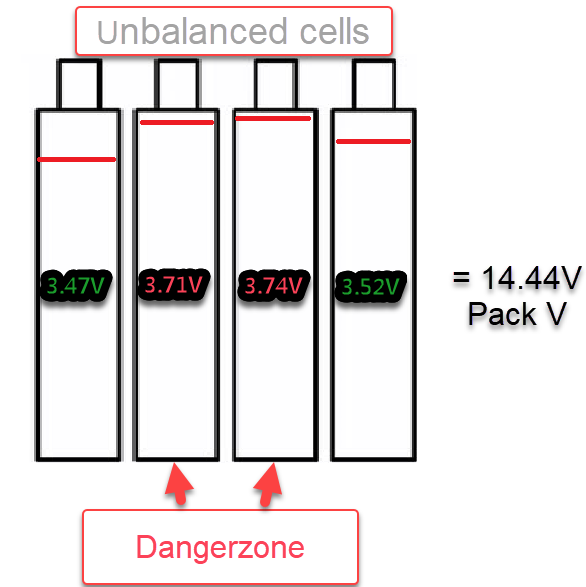
Know your loads before you buy!
The critical load data you need to know is the in-rush current for all DC Motors .This includes a windlass, electric winches or a bow thruster. You also want know your inverters Pre-charge in-rush. Unfortunately most DC Clamp meters cannot properly capture DC in-rush current. We own three DC clamp meters that claim to do in-rush but all except the Fluke meters fail miserably. The image below is one of our Fluke 376 meters capturing the in-rush current for a Lewmar V2 Windlass. This customer ruined his FET BMS (seen in an image above in this article) by using his “direct from China” drop-in battery to power his windlass.
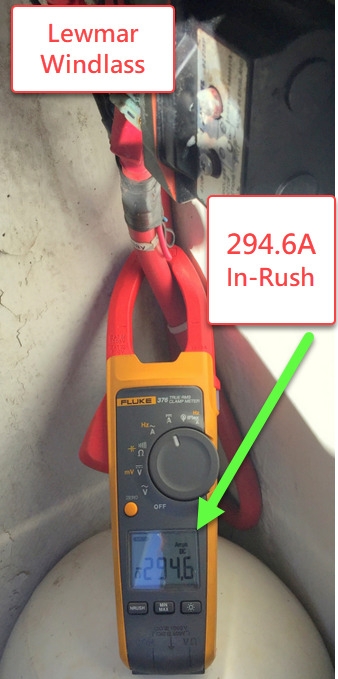
The image above is a prime example of how drop-in battery bank went wrong for this customer. he wanted to lighten the load in the bow of his sailboat so he installed a single drop-in battery to power his windlass.What he failed to understand was the BMS’s current handling rating . In just a few short weeks he destroyed his drop-in battery with his windlass when he failed to account for what the peak in-rush current handling of the BMS., Warranty? Sadly, exceeding battery spec was not covered!
Balancing
1) Balance current – The sealed internal BMS’s in most drop-in batteries don’t have a lot of passive balance current to work with, mA level current. We have seen some BMS specs suggesting they can only balance the cells at a maximum 10 – 20mA or just 0.01A to 0.02A. Low balance currents like this can work on a 100Ah battery but, as cells get larger, you really want to be looking for active balancing. We do not advise charging any passive balancing battery at any more than .2C. Charging passive balance BMS at more than .2C can worsen balance issues.
2) Balancing –Balancing Does not typically start until the cells are exceeding 13.8V or 3.45V per cell. Some are slightly higher and some slightly lower, just depends upon what you bought. Where the cells begin balancing should always be specified. If you don’t see this spec ask the manufacturer..More and more manufacturers are enabling balancing at 3.45-3.5VPC. We’re also starting to see more batts feature active balancing.
Tip: The Chinese often call balancing “equalizing”, not to be confused with lead acid EQ. This means that in order to ensure the cells stay in balance they need to get to a balance/eqalizing level at each 100% SoC charge-cycle. The reason drop-in makers suggest such high voltages is because balancing is always, done at the top-of charge with a FET based BMS. More and more manufacturers are enabling balancing at 3.45-3.5VPC. We’re also starting to see more batts feature active balancing.
3) Absorption Duration –The manufacturers, for obvious reasons, want a short absorption voltage duration, only enough to balance cells. Depending on the BMS this can be as short as 30 minutes (active balancing) to an hour (passive). With passive balancing an hour may not be enough time time to re-balance cells in a single charge, so they depend upon the battery getting to the balance voltage with each excursion to 100% SoC. If it does not get to a balancing voltage, the battery cells can become more out of balance and the FET BMS may not be able to catch up with out of balance cells.
LFP Warranties
LFP warranties = lawyer-Speak/marketing

“Each XXXXX brand Battery is Protected from over-heating, over charging…”
Warranty exclusion reality:
CONSIDER YOURSELF CONFUSED!!
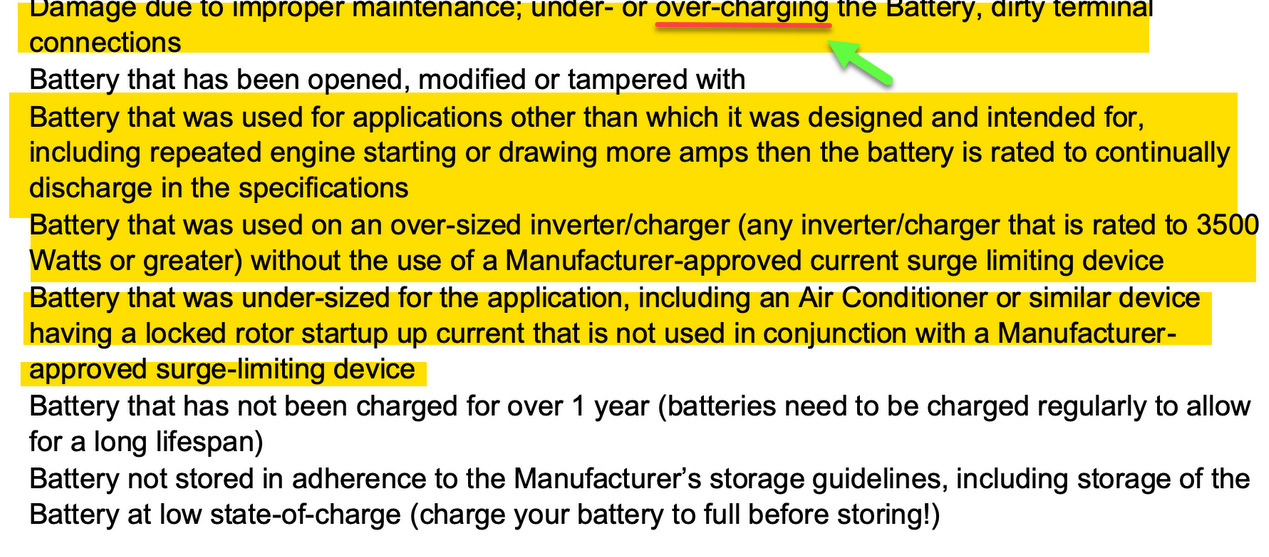 Exclusion: “Damage due to over-charging”
vs. the Marketing ;
“Each XXXXX brand Battery is Protected from over-heating, over charging…”If you’re wondering how a battery that has a BMS that “protects from over-charging Can be “over-charged“?Me too…
Warranties typically are not worth the paper they’re printed on, don’t buy your battery based on warranty.
WHAT ABOUT FLOAT CHARGING
Float charging is a relic that’s left over from lead acid battery charging. Lead acid batteries directly benefit from being held at 100% SoC. LFP do not benefit from this.. Float charging is not necessary for lithium iron phosphate batteries. That said float voltage of 3.375 VPC or 13.5V for a 12V battery is a fine float for LFP.
When LFP used to cost $10,000.00 to buy & install maximizing cycle life was a huge concern. Today with LFP pricing far lower than flooded deep-cycle batteries so, who cares if you loose a few cycles due to floating.
There are charger manufacturers out there who actually understand charging LFP batteries. Victron is about the best known. Victron has a specific setting in their custom menu that allows you to set a “storage” voltage this is a voltage the charger drops to after a short float has been done. It can be custom programmed to allow the batteries to self discharge down to about 50% SoC before the charger kicks back in and maintains the “storage voltage.”the only chargers or inverter/chargers we currently recommend for lithium iron phosphate batteries are Victron.
What About Storage?
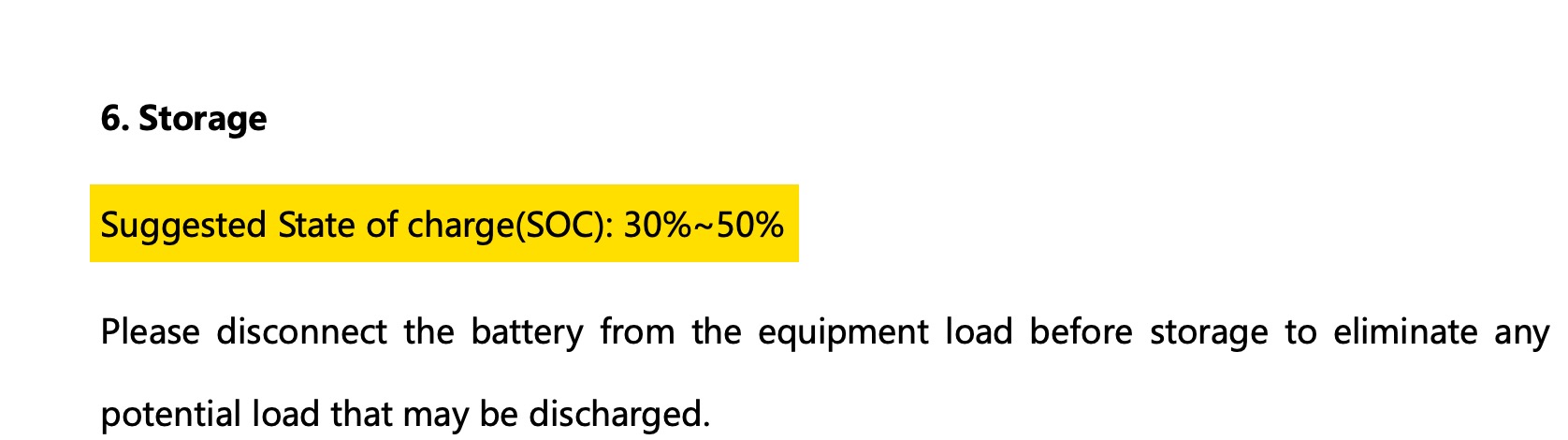
As mentioned above lithium ion phosphate batteries do not prefer to be sitting at or near 100% state of charge for long periods of time. This is why you will see, from nearly every single legitimate drop-in battery manufacturer, a recommendation for storing the batteries at or near 50% state of charge or less
Below are snapshots from lithium ion phosphate drop-in battery manuals or specification sheets .



What about “Hybrid ” Systems?
A hybrid system is where an owner decides to parallel Lead-Acid and LFP. Sure, you can find someone on YouTube to tell you what you want to hear, but this is not always what you should hear… Ask yourself what happens when the lead acid battery internally shorts if it is connected in parallel to LFP? ABYC does not prohibit hybrid systems but many batt manufacturers do, and ABYC defaults to the OEM.
Over-Current Protection?
Battery Banks & Over-Current Protection Article
The article above goes into great detail on this subject.Lithium iron phosphate batteries can throw a ton of fault current into a short but the fuse protecting the wire must have a suitable AIC rating. AIC stands for amperage interrupt current. AIC is different than the fuses trip rating. AIC is the maximum safe-current the fuse or breaker can trip under without having an unsafe-failure. For example if a battery has too much amperage, in a dead short ,Circuit breakers can actually weld-shut before they can trip. This is why AIC matters.
In summary, do your homework, purchase carefully, avoid direct from China imports when you can, install your system safely, use good quality charge equipment and you will be happy for many, many years and thousands of cycles.
Good luck and happy boating!
PLEASE HELP!
This site is 100% reader supported. My wife is urging me to shut it down as it just keeps costing us money. My stroke recovery is very costly as is authoring this site and keeping it secure.
Click the DONATE button below if you would like to make a donation via BUY ME A COFFEE.
